Dutch royal house earned nearly half a billion from slavery
See more DutchNews articles in your Google search results
See more DutchNews articles in your Google search results
Add as a favourite source on Google Add DutchNews as a favourite source on GoogleThe Dutch royal family, the House of Orange-Nassau, earned an estimated €576 million from slavery, mostly in the former Dutch East Indies, according to a new investigation into the monarchy.
The research was commissioned by king Willem-Alexander, who granted access to the royal archives and funded the inquiry.
“All stadtholders, kings, and queens, at least up to and including Wilhelmina, were convinced of the legitimacy of colonialism and its importance for the Netherlands,” lead researcher Gert Oostindie said during a ceremony on Friday to present the findings.
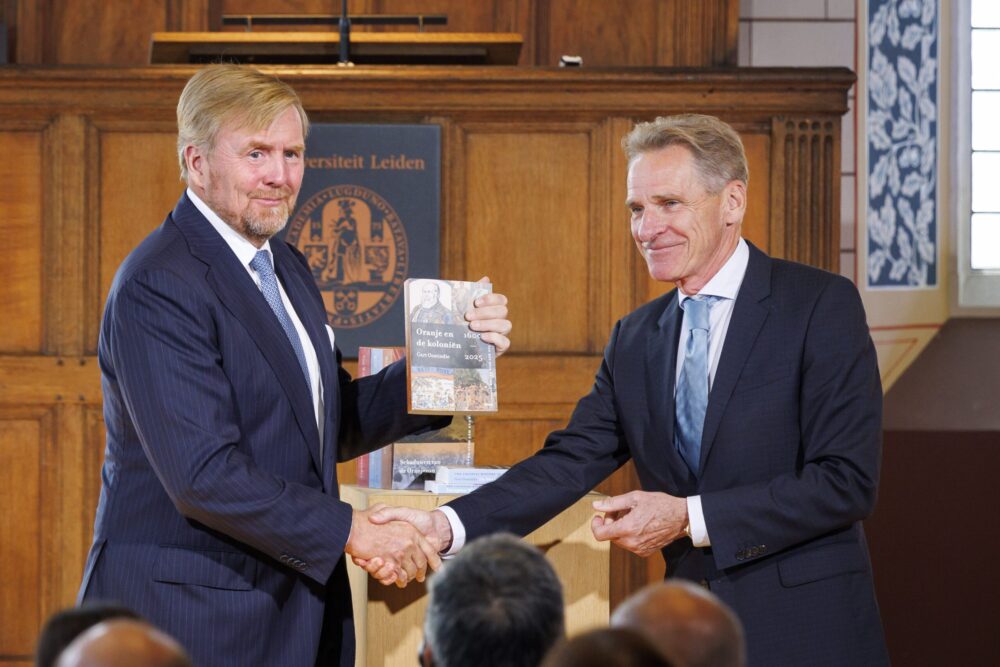
The 2,000 page report has been published into five books and was presented to the king. Willem-Alexander described the conclusions as “heartbreaking and confronting” during the gathering at the Academy Building in Leiden.
“I cannot change the past, but I can make a positive contribution to the present and the future to the best of my ability,” he said.
According to the research, the royals earned very little from the transatlantic slave trade, not because they were opposed but because they were unsuccessful.
Oostindie’s work found that while monarchs voiced support for the institution, few had a direct impact on policy.
Only King William I, who was in power from 1813 to 1840, had a direct hand in colonial slavery. Prior to that, leaders left it to the States General, the country’s early administrative assembly, or to the powerful Dutch East India Company (VOC).
After the reign of William I, monarchs were forced to share power with an increasingly important parliament, which made most of the policy decisions.
Willem-Alexander asked Oostindie, a former professor of colonial history, to conduct the investigation in 2022. Sixty researchers were involved in the nearly four year project.
In 2023, the king formally apologised for the Netherlands’ slave trading history during an annual commemoration for the abolition of the practice.
The monarch also stopped using a ceremonial golden coach which has repeatedly come under fire for a painted panel that depicts scenes of colonialism.
Research by the home affairs ministry in 2023 came to a similar conclusion. That study, carried out following a 2021 parliamentary motion, involved some 30 academics and historians and was published as the book Staat en slavernij (State and slavery).
Thank you for donating to DutchNews.nl.
We could not provide the Dutch News service, and keep it free of charge, without the generous support of our readers. Your donations allow us to report on issues you tell us matter, and provide you with a summary of the most important Dutch news each day.
Make a donation