Inburgering with DN: What you need to know about May 4 and 5
See more DutchNews articles in your Google search results
See more DutchNews articles in your Google search results
Add as a favourite source on Google Add DutchNews as a favourite source on GoogleThe Netherlands takes two days to mark the end of the war: a day to remember the fallen on the May 4, and then a day to celebrate and cherish the freedom they fought to protect, on the May 5.
Lesson 63: May 4 and 5
Germany invaded the Netherlands on May 10, 1940. On May 14 the devastating bombardment of Rotterdam put paid to any further resistance and the Dutch capitulated on May 15. Almost five years later, on May 5, 1945 the German troops capitulated to the Allies in Wageningen. The Netherlands was officially liberated.
Inburgering lesson 56, a brief outline of WWII in the Netherlands, has more.
May 4, nationwide ceremonies
Hundreds of Remembrance Day ceremonies take place in towns and villages all over the country on May 4. Among the most moving are those in isolated places commemorating members of the resistance executed by the German occupiers.
You will also find simple ceremonies at war grave sites where foreign fighters were buried in carefully tended graves all over the country.
Find a remembrance ceremony near you. You can also lay a digital wreath at one of 4,000 official memorials.
The main event
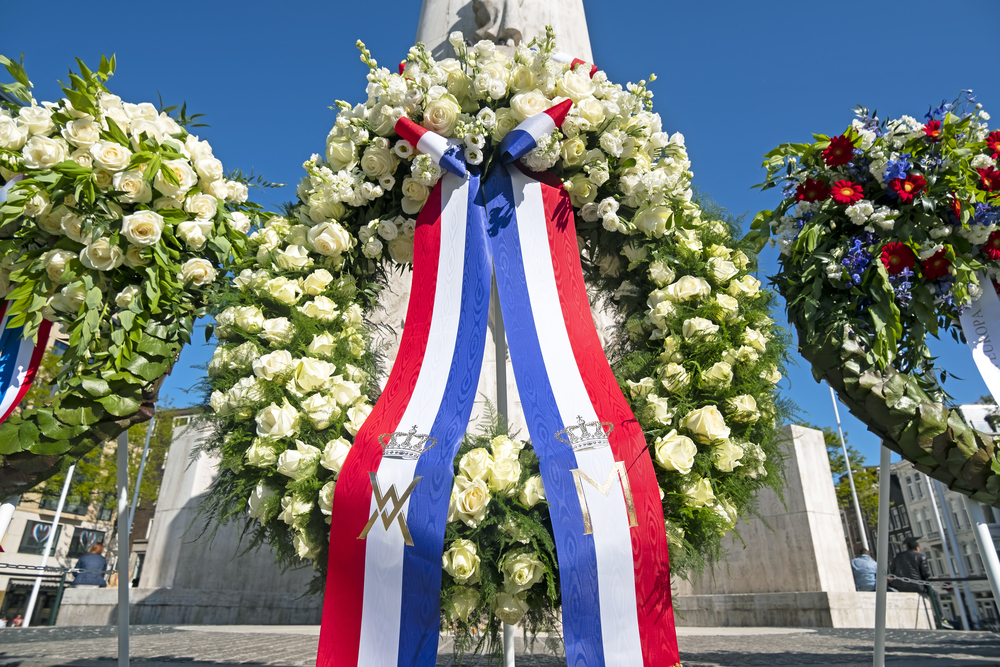
Every year at 8 pm on May 4, a formal Remembrance Day ceremony, headed by the king and queen, takes place in the Nieuwe Kerk followed by a wreath laying and two minutes of silence by the peace monument on the Dam, followed by speeches.
If you are not there in person – and the event is open to the general public – the ceremony is carried live on NPO 1 television, from 7.45 pm until 8.30 pm. It is worth visiting once, for the scale and the emotion.
Two minute’s silence
The two-minute silence is strictly observed all over the country. Public transport stops, cars pull over to the side of the road and there are no take-offs or landings at Schiphol airport.
Supermarkets also close early and if you have gone to a bar or restaurant, you may find the music dimmed and the staff asking you to be quiet.
Controversies
Every year there are calls for the scope of the Remembrance Day ceremony to be extended to cover others than just the Dutch war dead, both civilian and in service.
There is an alternative ceremony in The Hague on the Lange Voorhout at 7pm to remember all the victims of war.
May 5, the Freedom fire in Wageningen
The celebrations kick off in Wageningen, home to Hotel De Wereld, where the Germans signed the capitulation documents on May 5. The Freedom Flame is lit at midnight and from there 2,500 runners carry torches to light fires all over the country, marking the transition from remembrance to celebration.
The celebrations start
Every year the celebrations kick off in a different part of the country. In 2026 the honour goes to Utrecht, and television presenter Splinter Chabot will give the annual Liberation Day speech, focusing on what freedom means to him. After that, the party really gets started. Every five years, Bevrijdingsdag is an unofficial public holiday but 2026 is not one of them.
Liberation festivals
Around a million people each year visit one of the 14 Liberation Day Festivals across the country. Every year the organisers select a group of Ambassadors of Freedom, from the top performers of the moment. This year performing under the committee’s 2026 theme are De Jostiband, Karsu, La Fuente and Rolf Sanchez.
Liberation meals
A relatively recent tradition is that of the Liberation meal, in which local communities get together to celebrate. You can find your nearest meal – and there are hundreds all over the country via the website.
This year the Liberation soup recipe – from chef Janny van der Heijden – is for a creamy curried bean soup.
Amstel concert – Amsterdam
The traditional closing concert on the Amstel takes place on the evening of May 5 in the presence of the royals and local dignitaries and is open to the public.
Boat passes for the concert were given out by lottery some time ago; if you can’t get a decent view nearby, then the performance will be broadcast live by NOS on NPO 1 and coverage starts at 8.30 pm. The event always ends with a mass sing song of the Vera Lynn classic We’ll Meet Again.
Find out more about the Netherlands and WWII
Here are some of the highlights of our original coverage of World War II and the aftermath in the Netherlands.
- Europe’s last battlefied: remembering the Georgian uprising on Texel
- Museums and memorials: the places forever marked by WWII
- A suitcase full of secrets found in Amsterdam’s Jewish quarter after 70 years
- A memorial in Friesland tells the human story of a WWII bomber crew
- Hidden like Anne Frank: children who survived WWII tell their stories
- How an old archive cabinet revealed a hoard of WWII newspapers
Thank you for donating to DutchNews.nl.
We could not provide the Dutch News service, and keep it free of charge, without the generous support of our readers. Your donations allow us to report on issues you tell us matter, and provide you with a summary of the most important Dutch news each day.
Make a donation