From serving fries in the Netherlands to saving lives in Ukraine
Gordon Darroch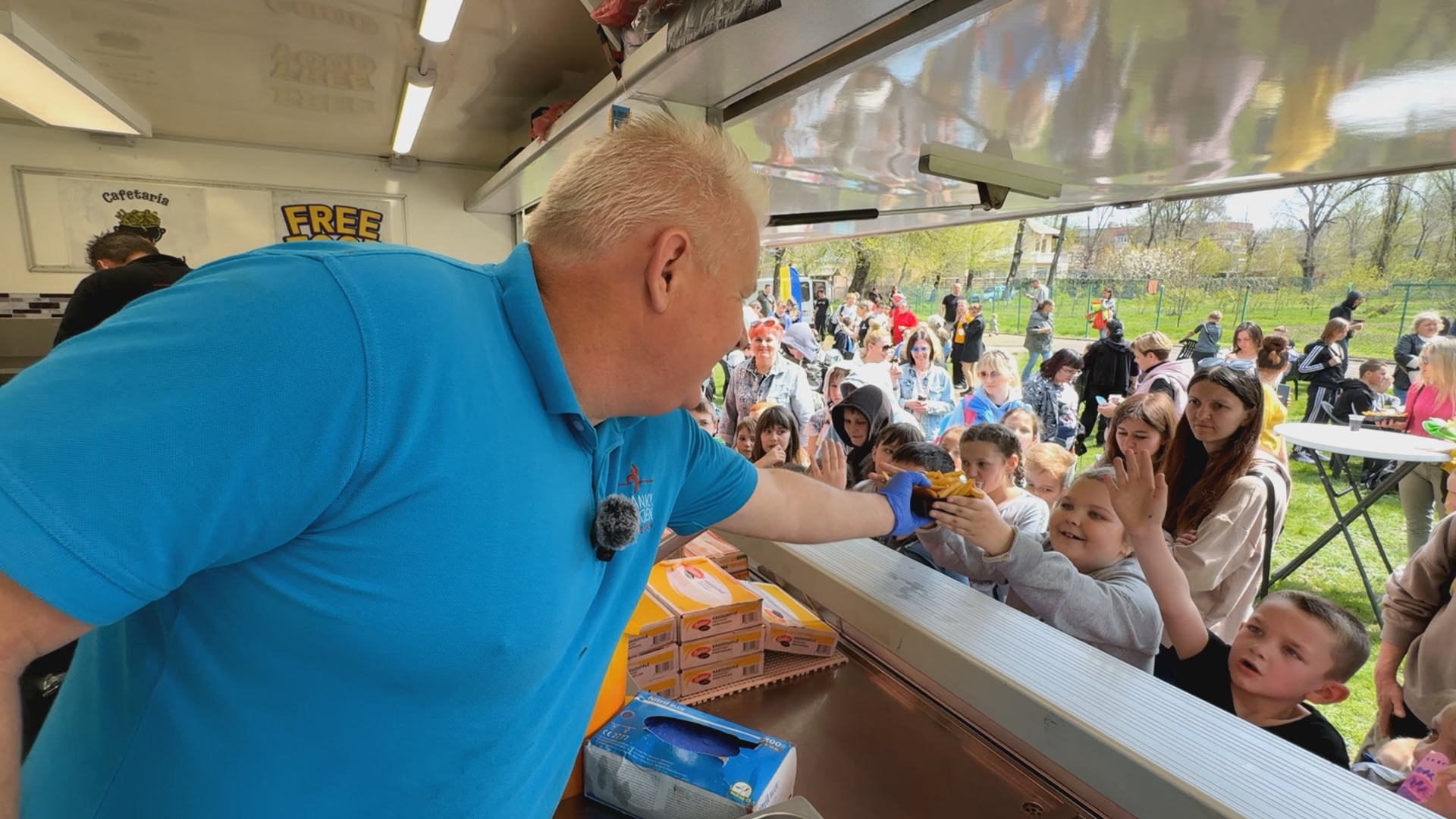
The images are still shocking after years of devastating war in Ukraine. Dust clouds and chunks of rubble swirl through the streets. People scamper outside, clutching bags and looking in all directions. Vehicle alarms and the cameraman’s heavy breathing cut through the gloom.
A building has had its side has ripped off, exposing empty rooms and dangling wires. A voice shouts in Dutch: “Coen! There could be another one!”
A blood-streaked hand comes into shot and points down the road, past a white-haired man in a polo shirt spattered with blood. It is June 23, 2023, and a Russian Iskander missile has just smashed into the cellar of a restaurant in Kramatorsk, killing 13 people who moments earlier were dining and chatting with friends.
Among the survivors are Franky van Hintum and Coen van Oosten, two roadside snack bar owners from Noord-Brabant who have spent the last four years giving fried food and shelter to Ukrainians driven from their homes.
The missile strike features at the start of an NPO documentary called Patatje Oorlog, a play on “war fries”, the Dutch way of serving chips topped with a messy blend of chopped onions, satay sauce, mayonnaise and chili.
The attack in Kramatorsk, 35km from the front line at the time (the Russians are now just 15km away) was the closest they have come to losing their lives.
“There were people 40 metres away who didn’t survive. We were sitting 12 metres away and we survived. We were lucky,“ says Van Hintum.
“The place where we sat was the only part of the restaurant where the roof didn’t fall in. And the missile went straight through into the cellar. If it had hit the concrete floor a lot more people would have died.”
Civilian target
Van Oosten – the man in the blood-spattered polo shirt in the footage – says his first thought was to go back to the Netherlands. “That’s it, never again,” he recalls. “It lasted maybe half an hour, 45 minutes. And then I looked around and thought: what the hell? This was a civilian target.”
“All I felt was anger,” says Van Hintum. In the documentary he describes how the missile struck as he was paying the bill. He handed the waitress a banknote, with a hefty tip “to give her a good day”. Minutes later she was dead.
Franky and Coen only planned to make one trip to Ukraine. When the Russian invasion began on February 24, 2022, Van Hintum sat at his home in the Netherlands and watched the news coverage of refugees forming long queues at the Polish border.
“The accommodation wasn’t well organised because it was unexpected,“ Van Hintum says. “Thousands of people every day, all needing food and a place to sleep.”
Van Hintum knew Ukraine well, having met his wife Tanya, from Kyiv, 35 years ago, and felt compelled to do something. “I earned a living from my fries van and I thought: it’s a drop in the ocean, but I could make French fries for 2000 people a day.
“So I phoned Coen and said: ‘I’m planning to go out there in the van. Do you fancy coming with me?’ We put €2,500 each into a kitty and used that to buy chips and snacks.”
“We thought we’d be there two or three weeks,” says Van Oosten at the depot on an industrial estate in Helmond that serves as their Dutch base. Outside, Ukrainian flags, a banner with the logo ‘Franky and Coen into the breach’ and a transit van proclaiming “Holland supports Ukraine” in large yellow letters testify to this unconventional charity venture.
“We didn’t know where we were going, but we ended up in Przemyśl, near the Polish border with Ukraine,” says Van Hintum, 57. “There was a big refugee centre there in a former Tesco supermarket where they had set up camp beds for the Ukrainians. And that was where we parked the van.
Bullet-ridden buses
“In the 10 days or so we were there we saw how gruelling it was. People arrived who had been travelling for a week from the other side of the country. It was total war.“
Van Oosten, 53, adds: “They showed us on their phones what they had lived through. Buses full of children that were riddled with bullets.”
After 10 days Franky and Coen packed up and returned to the Netherlands, but they could no longer turn their backs on the war. “As we drove back in the van, after maybe 10 minutes, we looked at each other and we both agreed: this isn’t finished,” says Van Hintum.
Four years after that first mercy dash, Franky and Coen run a slick operation shifting lorryloads of donated goods from a depot in Vught to their distribution centre in Dnipro. Every seven weeks they make the long road journey from Noord-Brabant to the war zone. It has become an ingrained routine: three weeks in Ukraine, four weeks to restock and recuperate in the Netherlands, which lately has included speaking tours to raise funds and awareness that the war is far from over.
They evacuate people living near the front line, run a refugee hostel in Dnipro – the Holland House – and fry potatoes for up to a thousand people a day, in the heart of the war zone. They organise holiday camps for children growing up in the cacophony of war, shoot footage for a documentary series on RTL, Patatje Hoop, and are in negotiations to open a second Holland House later this year.
“There’s a war over there!”
“We went back two or three times, just frying chips,” says Van Hintum. “And then one of our neighbours who was cooking Bratwurst said to us: we’re going across to Ukraine tomorrow. Will you come with us?”
Van Oosten recalls replying: “No! There’s a war over there!”
“But we told him: come back and tell us what it’s like and we’ll see,” Van Hintum says. “A day or so later he phoned and said he was a few kilometres over the border. It’s just like in Poland, he said, except that the need was much greater because there was less support. That was the first time we went to Lviv, for a week.”
Franky and Coen never intended to go to war. But every time they parked their chip van in a Ukrainian town, they heard harrowing stories and pleas for help from people living nearer the front line. Donations were flowing in as people in the Netherlands responded to appeals from charities and aid agencies – far more than they could spend on deep fried snacks and frozen French fries.
“We kept on going”
“We said to ourselves 100 times: this is where we draw the line,” says Van Hintum. “But every time we’d think: the Russians are gone from Irpin and Bucha, so we’ll go there. And then,” he adds with a chuckle of disbelief, “we kept on going.”
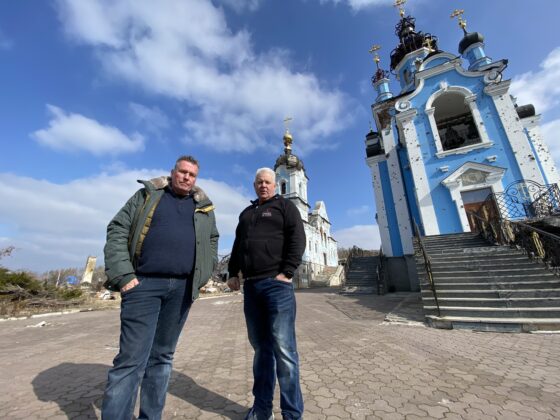
After the Russians retreated from Kyiv in early April, they headed towards the capital. In Bucha they found devastation and mass graves, evidence of war crimes that Russia continues to deny. “That was the first time we saw the war,” Van Hintum says. “Buildings that had been shot to pieces, burned-out tanks beside the road.”
“We heard the noises for the first time in Izyum,” adds Van Oosten. “The exploding grenades, the shelling.”
“We were just two chip fryers from the Netherlands,” Van Hintum says. “We hadn’t done any training or anything to prepare ourselves for this.
They met Denys Khrystov, an aid worker who evacuates villagers from the front line to ahd has built a large social media following by posting the footage online.
Khrystov, 42, is nicknamed “The Dutchman” because he carried out his early rescue missions in a Dutch-registered van. When he saw two real Dutchmen handing out chips, he asked them to accompany him to Netailove, a village under attack since the invasion of Donbas in 2014, where 85 people were still holding out.
Drone danger
The journey brought them within three kilometres of the front line. A film on YouTube shows Franky and Coen stocking up with bread, medicines and fruit at a supermarket before driving along an increasingly bumpy road lined by craters and burned-out cars.
The sound of shelling grew steadily louder as they approached the village. Along the way Khyrstov mentioned that he’d recently gave his drone jammer to another rescue team. “So now it’s even more dangerous,” Van Hintum commented anxiously. “Very dangerous,” Khrystov replied.
They handed the bread to a local woman, Svetlana, but were unable to persuade her to leave the village. “If the front line moves this way, there won’t be any village left,” Khrystov explained in the car. Netailove, which had a population of 1,100 before the war, fell to the Russians two months later and has since been destroyed.
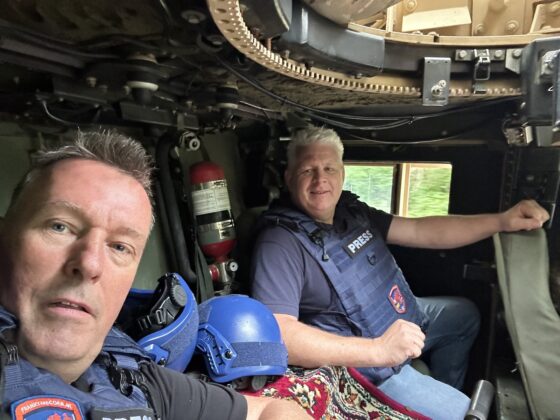
The evacuations have become a staple of Franky and Coen’s visits to Ukraine: two or three on every three-week round trip. They bought a former Brinks armoured truck, used to transport money, and equipped it with a drone jammer. Drones are an ever-present danger in Ukraine and a jammer offers only partial protection. Networks of fibre-optic cables dangle overhead near the front line. “If the drones are hanging from there, we’ve got a problem,” Van Hintum says. “They can still hit us.”
The two men weigh up the risks carefully, he says. “We don’t do kamikaze. If it’s an old man who doesn’t want to leave, we won’t go in. But if we can evacuate a family with three children, we’re willing to take more risk.”
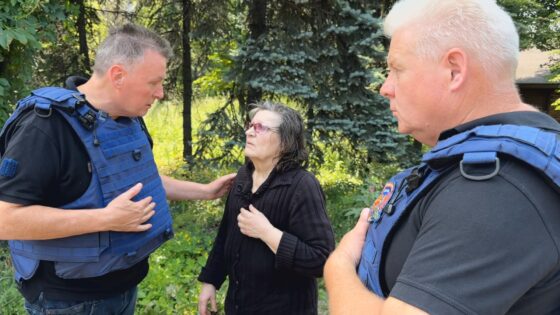
Their work with Khrystov was the reason they set up the Holland House, a refugee hostel in Dnipro, 80km from the front line. Van Hintum says: “We asked him what he needed and he said: the people I pick up have to go into hostels where there are 20 or 30 people in a room. A lot of people would rather stay in their homes on the front line. If I had a better alternative, I could evacuate more of them.”
There are no shared dormitories in the Holland House: the refugees live alone or in a room with their families, with food, a generator providing electricity and heating and a “shop” where clothes and items donated in the Netherlands are handed out.
Making it personal
Among the first people they took in was Svetlana, the woman they were unable to persuade to leave Netailove. She and her husband fled the village a few weeks later when their house was hit by a Russian mortar shell.
“We only take people who have to be evacuated in armoured vehicles,” Van Hintum says. “They can stay for two months and in that time we look for a good alternative. That gives them time to recover and start thinking about the future.”
Khrystov also made them aware of the importance of filming and posting footage, in an age when social media has become another front line. “The biggest gestures are the ones nobody sees,” Van Hintum says. “If we send 500 generators, it’s a big investment and it helps 500 families.
“But that film is probably less effective than one that shows us giving a 92-year-old lady €80 to buy food at the market. People respond to that more because it’s personal. It feels uncomfortable to make films of elderly people, but it means we get more aid, which lets us help another 100 old ladies.”
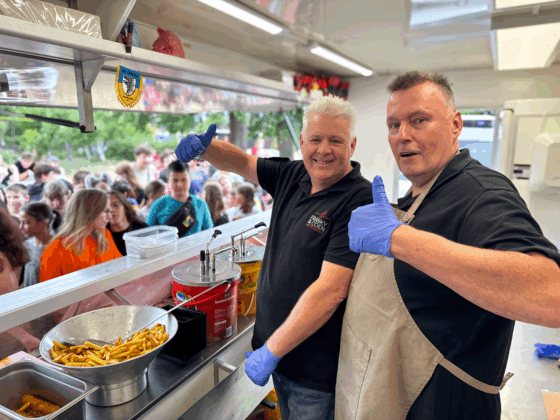
Franky and Coen have become media savvy operators in the last four years. They registered as journalists so they can work with local film crews in the war zone. Their documentary series, Patatje Hoop (“chips of hope”) is the reason why their donations are still holding up four years into the conflict, Van Hintum says. “We don’t have a big pot of money, but it means we can keep doing what we’re doing.”
The series lets Franky and Coen to show all aspects of life in Ukraine close up: going on patrol with a team shooting down drones, distributing supplies at the Holland House and visiting injured evacuees as they recover in hospital. They can work without interpreters thanks to Van Hintum’s fluent Russian, still the main language in eastern Ukraine. A strong narrative thread is the physical and emotional connection: hugs, handshakes and tears of gratitude.
“It’s important for the Ukrainians to show the positive things,” says Van Oosten. “A bag of chips takes away people’s worries, even if it’s just for an hour.”
“We were in western Ukraine one time with the van and there was a live band playing,” Van Hintum recalls. “One old man took his chips without saying much. But we had a poster that explained who we were and where we came from, and when he stood and read it, he was completely overwhelmed. That sort of thing really touches you.”
Holiday camps
Van Oosten’s face lights up as he talks about the children’s holiday camps they run in the Carpathian mountains. “These kids have grown up in Kherson and Zaporizhzhia. They know the sound of drones, mortar fire, incoming glider bombs. And we give them a week of just being children. Playing, messing around, being cheeky.
“I remember one boy with a cleft palate. On the first day he looked distant and uncomfortable. On day two he started smiling. You saw him growing every day. His care worker said: that boy has never had a childhood, never.”
“I never knew until now how good it feels to do good things,” Van Hintum says. “But sometimes it’s exhausting too. There are times when you think: maybe it’s time to stop.”
He points to a photograph on the wall of the cabin of them that shows them with two of their closest friends: Olena Hub, a journalist who wrote under the professional name Alyona Gramova, and cameraman Yevhen Karmazin, known as Zhenya. They were killed on October 23 last year by a Russian drone in Kramatorsk, a targeted strike that was condemned as a war crime by Ukraine’s president, Volodymyr Zelenskyy.
“Nothing I’ve experienced in my life has hurt like that,” Van Hintum says. “My parents died, but they were older. You accept that that’s going to happen. But they [Alyona and Zhenya] were murdered. They were aid workers, friends and journalists. She was the voice of the Donbas.”
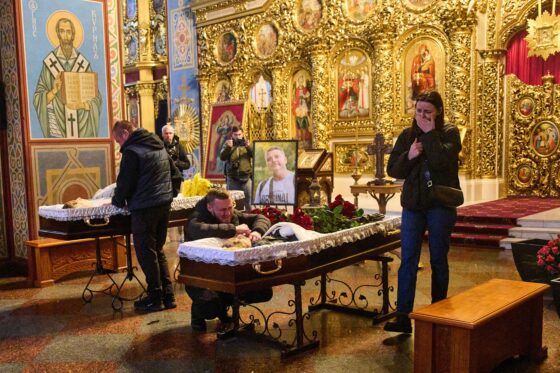
They had become close friends and colleagues since Gramova, 43, interviewed the two Dutchmen for local TV channel Freedom. “She had to wait a heck of a long time because we wouldn’t come out of the chip van until we’d served everyone,” Van Hintum recalls. Gramova and her driver, Sacha, were having dinner with Franky and Coen on the night that the missile struck the restaurant in Kramatorsk, when their choice of table saved their lives.
What stings, Van Hintum says, is that he and Van Oosten were on the verge of offering her a full-time job so she could quit journalism. “Not a huge sum by Dutch standards, but the kind of offer she would never have said no to.
“Alyona was scared at the end. She was sleeping in corridors. She had told our driver to turn back a few times because it was too dangerous. But she knew that if she stopped, there was a good chance Zhenya and Sacha [the driver] would be sent to the front.”
Gramova was killed on what should have been her final assignment in Kramatorsk. Karmazin had found a job with a security firm that excused him from military service, clearing the way for her to quit. “I have a huge sense of guilt,” Van Hintum says. “I think about it every day. Objectively you can say we shouldn’t feel guilty, but I know that if we’d handled it differently, they wouldn’t have been there.”
Dogs and cats
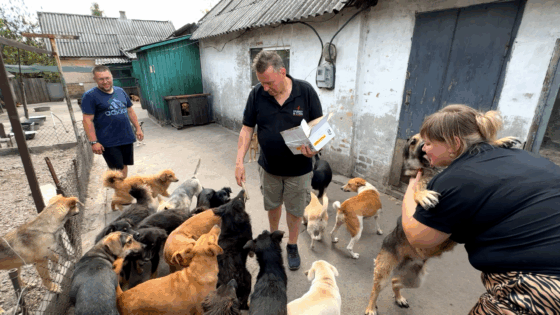
The grief is still raw, but Franky and Coen are as committed as ever to Ukraine. They hope to open a second Holland House near Cherkasy, on the Dnieper river, by the summer with facilities for dogs and cats as well as people. “A lot of people refuse to flee without their pets,” Van Hintum explains. “Almost everyone still living there has animals. So our new location will let them take one dog or one cat with them and stay for six months.”
The recent winter has been the hardest since the war began: bitterly cold, with night temperatures of minus 30C in some places, and sustained Russian attacks that have left towns and cities, including the capital, Kyiv, without heating and electricity. “For the people living there it’s hell,” he says. “We were in Kyiv handing out soup to homeless people who’ve been sleeping outside. And the attacks are getting worse. People don’t realise because it’s not in the news so much, but the number of drones is doubling every month.”
Neither regrets the decision they made to go back to Ukraine after that first trip in February 2022, but the loss of their friends has changed their perspective. “It’s different now,” says Van Hintum. “The sense of adrenaline has gone. It’s purely about results. And we weigh up the risks more carefully. When we do something intense my knees tremble more than they used to.”
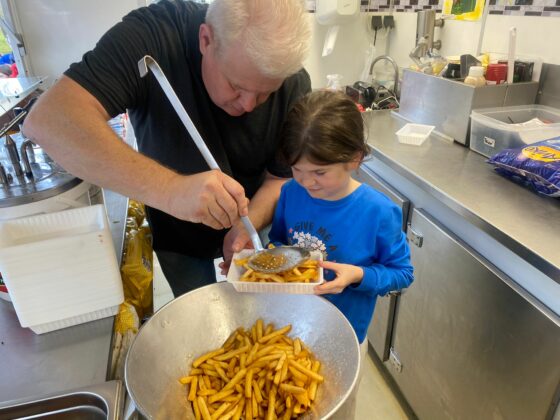
“What I’ve been through in the last four years has meant a lot,” says Van Oosten. “I’ve changed a lot as a person. I used to be a lot more short-tempered.”
“We’ve asked ourselves: what if the war ended tomorrow and we had a year left to work,” says Van Hintum. “Would we carry on, or would we stop? Would we start another project? And the conclusion was that we don’t know. It depends how tired we feel and what we can do financially.”
Van Oosten says: “If there’s a call for help, I’ll be the first to put my hand up.”
You can find out more about Franky and Coen’s work in Ukraine and donate at www.frankyandcoen.nl
Thank you for donating to DutchNews.nl.
We could not provide the Dutch News service, and keep it free of charge, without the generous support of our readers. Your donations allow us to report on issues you tell us matter, and provide you with a summary of the most important Dutch news each day.
Make a donation