Crunch time for Dutch coalition talks: will JA21 join the table?
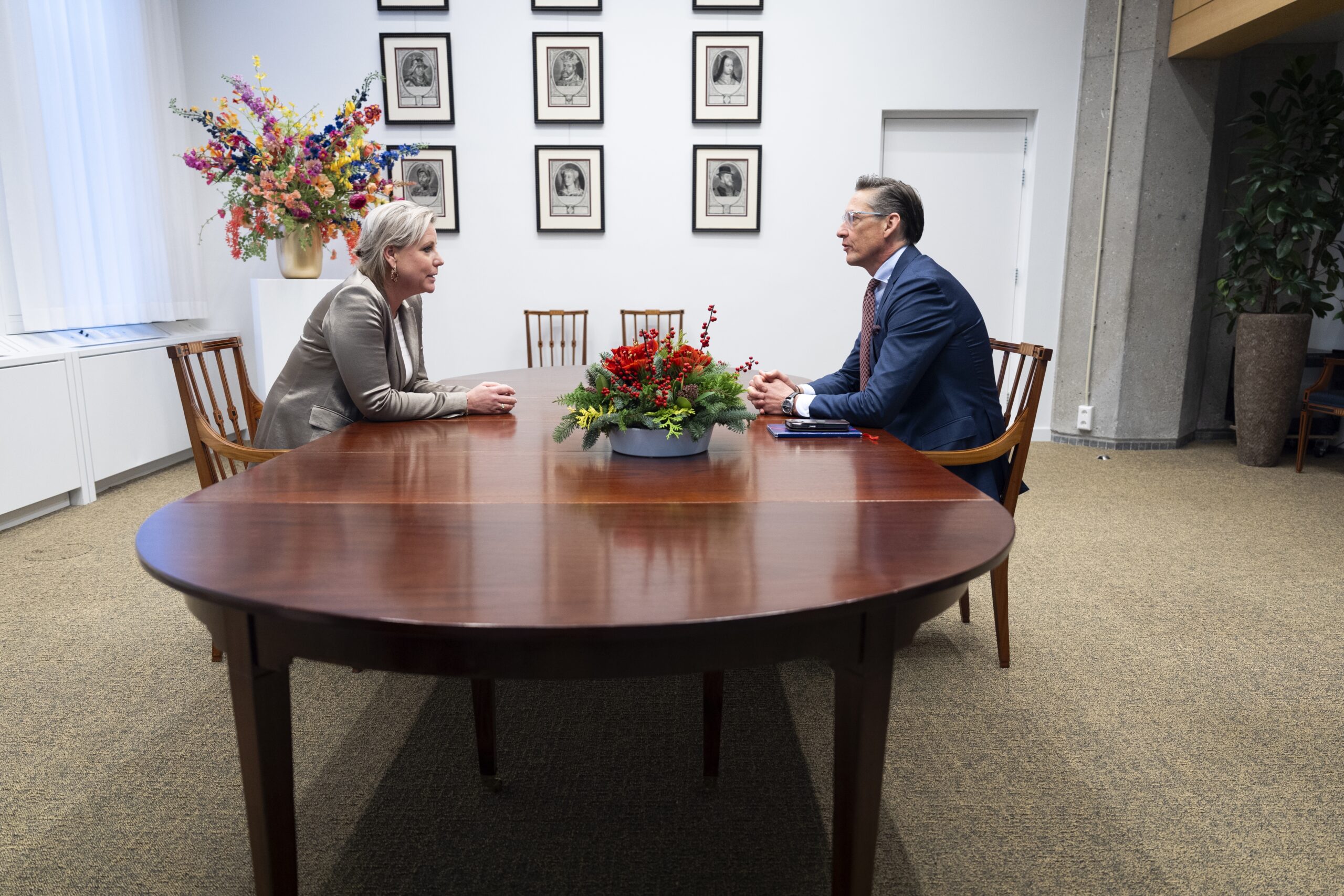
The three parties holding talks to form the next Dutch government are expected to decide this week whether to bring more partners on board or press ahead with a minority coalition.
Maastricht university president Rianne Letschert, appointed by D66 to chair the negotiations, said the coming week would be “crucial”, particularly in deciding whether the far-right JA21 should join the negotiating table.
Neither outcome is straightforward for the current partners, the progressive-liberal D66, the conservative Christian Democrats (CDA) and right-wing liberal VVD. Letschert has been given a deadline of January 30 to report back to parliament, by which time the make-up of the coalition is expected to be finalised.
A three-party coalition with just 66 seats – 10 short of a majority in the lower house – is unprecedented in Dutch politics, just as D66 leader Rob Jetten promised to build a “stable cabinet” following the “failed experiment” of the previous two years.
The left-wing alliance of GroenLinks-PvdA, which won 20 seats in October’s general election, would give the cabinet a majority, but VVD leader Dilan Yesilgöz has firmly ruled out any kind of collaboration with Jesse Klaver’s party.
D66 resistance
Jetten dropped a heavy hint in December, in a letter to D66 members, that he preferred a minority cabinet that governed through “open co-operation with left and right”.
Yesilgöz favours teaming up with JA21, which broke away from the even more radical Forum voor Democratie four years ago, but there is strong resistance to that option in Jetten’s party.
The differences were reinforced this week in the wake of the US intervention in Venezuela and the arrest of its president, Nicolás Maduro, and will almost certainly surface again when parliament is recalled to debate the issue on Thursday.
While Jetten released a three-paragraph statement calling for the Netherlands and the EU to “adhere to the international legal order and respect for the sovereignty of nations”, JA21 spokesman Michiel Hoogeveen struck a very different tone.
“These developments show we live in a multipolar world of great powers and spheres of influence, dominated by power politics. The era of global governance is ending,” he wrote on X, formerly known as Twitter.
Maduro was een wrede dictator. Hij stortte zijn land in de afgrond, verloor de verkiezingen en bleef onrechtmatig aan de macht. Veel Venezolanen zullen opgelucht zijn dat hij weg is.
Tegelijkertijd geldt: dit is niet de manier. De bombardementen op Caracas, het gevangennemen… pic.twitter.com/Y0UsxvCj58
— Rob Jetten (@RobJetten) January 3, 2026
A formal alliance with JA21 would leave D66 on the left flank of a right-wing, forcing Jetten to make much tougher compromises as prime minister on issues such as asylum and nitrogen reduction.
Public spending
Another likely bone of contention is public spending, where the parties have very different ideas about how to balance the books.
All partners agree that defence spending has to be ramped up to meet the new Nato baseline of 3.5% of GDP, as agreed at last year’s summit in The Hague, plus another 1.5% to be invested in vital infrastructure.
But while D66 want to raise taxes and invest heavily in education and technology, the fiscally hardline VVD says cuts should be made in healthcare and social security.
JA21 wants to go even further with €6.1 billion of savings, largely by almost totally abolishing the budget for international development, which would again bring it into conflict with D66.
Yesilgöz also promised during the election campaign not to let the next government touch mortgage interest tax relief for homeowners, which both D66 and CDA say should be scaled back to raise more tax income.
CDA reticence
Henri Bontenbal, leader of the centre-right CDA, has been keeping his cards close to his chest during the coalition talks, but his party is indispensable for any coalition.
Bontenbal said a month ago that a coalition with JA21 was the “most logical option” but quickly qualified his statement, insisting it was an assessment of the state of play rather than his personal preference.
If JA21 are kept out of the coalition, the three parties will still depend heavily on its support to pass its legislation, especially since the VVD has ruled out any kind of formal co-operation with GL-PvdA, even a confidence and supply deal.
D66, CDA and VVD have ruled out working with Geert Wilders’ far-right PVV or the pro-Russian fringe party Forum voor Democratie, who have 33 of the 150 seats in parliament between them.
That means a minority government may end up replying on the support of smaller parties such as the ChristenUnie, the Socialists (SP), the farmers’ party BBB and pensioners’ party 50Plus to pass some of their legislation – especially in the Senate, where the BBB holds 12 of the 75 seats.
Thank you for donating to DutchNews.nl.
We could not provide the Dutch News service, and keep it free of charge, without the generous support of our readers. Your donations allow us to report on issues you tell us matter, and provide you with a summary of the most important Dutch news each day.
Make a donation