Parkinson’s map of the Netherlands shows complex risk factors
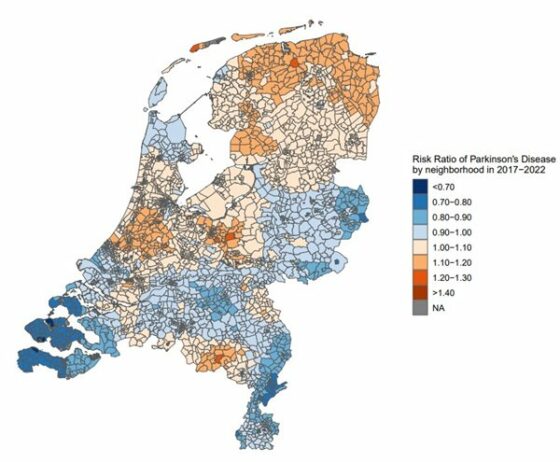
The risk of developing Parkinson’s disease appears to be higher among men, people with degrees and people who live in the north of the Netherlands, according to new research by Utrecht and Radboud universities.
The researchers mapped cases of Parkinson’s using data from 2017 to 2022 to show where the disease occurs most often. However, they warn, the risk of developing Parkinson’s builds up over decades and the map simply provides a snapshot of current cases.
“The geographic distribution of Parkinson’s at the time of diagnosis does not clearly correspond to the distribution of potential risk factors, such as air pollution or certain types of agriculture,” the researchers said.
“For example, air quality in the north of the Netherlands is relatively good. This does not mean there is no link with environmental factors. Each environmental factor individually has only a limited impact, but because almost everyone is exposed to them, they can collectively play an important role.”
Further research, they say, is needed at an individual level to try to determine why a given person develops the disease.
The risk of developing Parkinson’s depends on what your eat, where you work and what you breath over a period of years,” Radboud professor Bas Bloem told Trouw. “People move, change diet and job and the world around us changes. There is also a genetic link, which we think is around 15%.”
Men are more likely to develop Parkinson’s than women, which may be because men are more likely to be exposed to harmful substances at work, while women may be protected from brain damage by their hormones.
Lifestyle factors, such as smoking, may explain why people with a higher socio-economic position are more likely to develop the disease. People who smoke have a lower risk, but the reason why is still unclear.
Some 63,000 people in the Netherlands currently have Parkinson’s. Over the past few years, an average of 3,724 people have been diagnosed with the disease, a figure that is stable, the researchers said.
Thank you for donating to DutchNews.nl.
We could not provide the Dutch News service, and keep it free of charge, without the generous support of our readers. Your donations allow us to report on issues you tell us matter, and provide you with a summary of the most important Dutch news each day.
Make a donation