Prinsjesdag: what you need to know about the rituals
See more DutchNews articles in your Google search results
See more DutchNews articles in your Google search results
Add as a favourite source on Google Add DutchNews as a favourite source on GoogleThe government presents its 2027 spending plans to parliament and the public on Tuesday. Here’s what you need to know:
Prinsjesdag, the day the king opens the new parliamentary year and the government publishes its plans, has taken place on the third Tuesday in September since 1887.
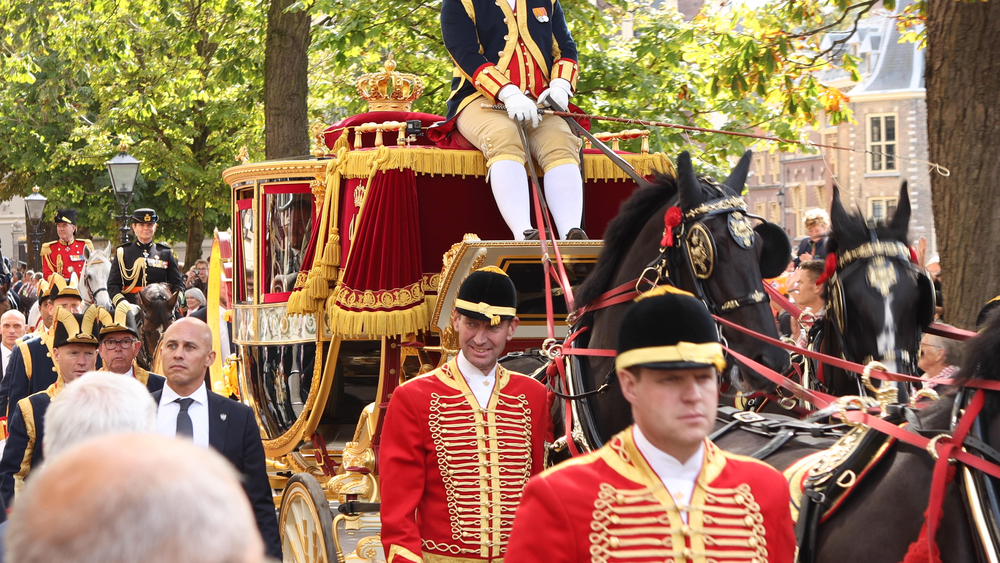
The day’s events kick off at 1pm when king Willem-Alexander and queen Máxima travel from Noordeinde palace to the Koninklijke Schouwburg theatre in a horse-drawn coach, accompanied by princess Amalia, who has ridden with her parents every year since her Prinsjesdag debut in 2022.
The coach is the Glass Coach, which was delivered to King Willem I in 1826 and marks its 200th anniversary this year. It has been used since 2016, when the Golden Coach, with its side panels depicting black slaves submitting to a white woman, was taken away for restoration. That work was completed in 2021, but the king said in 2022 that the Golden Coach would not be used again until society is ready and it has not been seen on Prinsjesdag since.
At the theatre the king will address the members of the upper and lower houses of parliament, plus the diplomatic corps, and outline the government’s plans for the coming year. Reading out the troonrede (speech from the throne), which is written by the government, is one of the monarch’s main ceremonial jobs.
The speech is traditionally given in the splendour of the Ridderzaal, or knights’ hall, on the Binnenhof, but this is the fifth year running it takes place at the theatre because the parliamentary complex is undergoing major renovations.
Nevertheless, the hats worn by female guests – the hoedjesparade – are likely to provide much fodder for the gossip columns, as they do every year.
After the speech, the royals will return to the palace by coach and appear on the balcony with other members of the family to wave at the crowds at around 2pm.
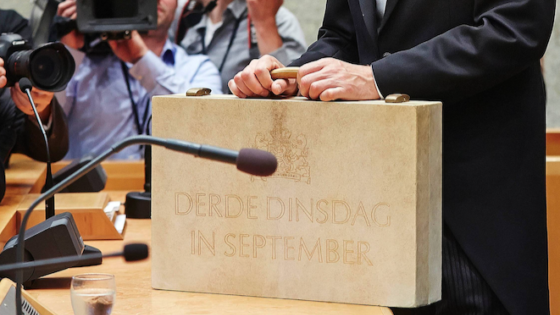
At 3pm, finance minister Eelco Heinen will present the budget, or rijksbegroting, to parliament. The paperwork is always delivered in the same briefcase, a tradition which started in 1947, although the current goatskin case has only been in service since 1964. It is Heinen’s third budget but the first for the Jetten cabinet, the minority coalition of D66, the VVD and the CDA which was sworn in in February.
The rijksbegroting literally means state budget and sets out how much money each ministry has been allocated for the coming calendar year and what the spending priorities are. A close cousin to the rijksbegroting is the miljoenennota, which is the breakdown of the finances, outlining the economic and financial situation in the country.
A third document is the annual macro economische verkenning (MEV) or macro-economic outlook, which is drawn up by the government’s economic policy advisory agency CPB. It contains all the forecasts which ministers have used to work out their spending plans and calculates what the effect of those policies is likely to be.
Leaks
Another Prinsjesdag tradition is the way much of the budget is leaked to the media in advance, and 2026 is no exception. Details reported by the Dutch press so far include a marginal fall in spending power for everyone except pensioners and low-income households, a delay until 2029 in cutting unemployment benefit from two years to one, a scrapped €60 increase in the health insurance own risk payment, extra money for education, housing and defence, and a €100 to €300 sport pass for 12 to 23-year-olds.
Debates
On the Wednesday and Thursday after the formal presentation of the budget, MPs debate the main socio-economic points with the prime minister and finance minister in the Algemene Politieke Beschouwingen, which is seen as the most important parliamentary debate of the year. It will be prime minister Rob Jetten’s first as head of government.
Opposition leaders will come up with their own alternative budgets and argue for changes to the government plans. The government always agrees to include some of their measures.
In the following weeks, each ministry’s spending plans will come under the spotlight in a two-day debate with each individual minister in the hot seat.
Legislation
As the debates progress, legislation based on the plans will be drawn up and voted on – and often little remains of the original idea. This year the changes are likely to be particularly strong, given that the coalition is short of a majority in the lower house and in the senate, and its attempt to agree a package with opposition parties before Prinsjesdag collapsed. Jetten himself has said the budget presented on Tuesday is “not the end”.
There is also usually a rush to get key changes to the law signed and sealed before the end of the year.
DutchNews will publish a summary of the king’s speech and a round-up of the government’s main plans on Tuesday afternoon.
Thank you for donating to DutchNews.nl.
We could not provide the Dutch News service, and keep it free of charge, without the generous support of our readers. Your donations allow us to report on issues you tell us matter, and provide you with a summary of the most important Dutch news each day.
Make a donation