NL is world’s top hub for Israeli capital – arms firms included
Louis Gore-Langton
See more DutchNews articles in your Google search results
See more DutchNews articles in your Google search results
Add as a favourite source on Google Add DutchNews as a favourite source on GoogleThe Netherlands is the biggest destination for Israeli capital in the world, holding €44.9 billion in investment in 2024 – nearly four times as much as the US, according to new research by Amsterdam-based corporate watchdog SOMO. It is also the world’s second biggest investor into Israel, with €27.3 billion invested there in 2024 alone.
Much of the money is routed through Dutch holding companies with little or no presence in the country; foreign businesses use the Netherlands and its favourable tax regime as a conduit for their investments.
These companies include Ercas BV, a European holding company of Israel’s state-owned arms manufacturer Rafael. It has no employees and no street address, and its registered seat is simply “The Hague”, yet through it Rafael owns weapons factories in Germany, Spain and the UK, the research shows.
Rafael answers to Israel’s finance ministry, headed by Bezalel Smotrich, who has been banned from entering the Netherlands since July 2025, when the cabinet declared him persona non grata for inciting settler violence against Palestinians and calling for ethnic cleansing in Gaza.
Money flowing through
The money should not be mistaken for capital put to work in the Dutch economy, Jasper van Teeffelen, the report’s author, told DutchNews. “It’s not as if all this €45 billion is invested in the Netherlands, building Dutch factories and setting up Dutch offices and having Dutch employees and really supporting the Dutch economy,” he said. “This is money that is flowing through the Netherlands.”
The Netherlands levies no withholding tax on interest leaving the country, has one of the world’s largest networks of tax treaties, and makes it easy to set up a company with no real domestic activity.
This is advantageous because when profits, interest or royalties cross a border, most countries tax them on the way out, unless a treaty between the two countries reduces the rate. The Netherlands has treaties with some 100 countries and charges nothing on interest and royalties leaving the country, so payments sent via a Dutch holding company arrive largely untaxed. The company needs no physical presence but just appears Dutch on paper.
Successive cabinets have defended these arrangements as investment climate policy, but campaign group the Tax Justice Network ranks the country among the world’s worst enablers of corporate tax abuse.
Of the €27.3 billion invested into Israel through the Netherlands, less than €1 billion came from Dutch companies themselves.
“Who is benefiting from these investments?” Van Teeffelen said. “Is it the Israeli companies? Is it the Dutch public? Ultimately the ones who gain the most are the corporations that are using this system.”
Not all letterboxes
Not every company in the report fits the same pattern, he said. “In the case of Rafael, it really is a letterbox company. They don’t have any employees in the Netherlands. But some of the others do have employees here.”
Pharmaceutical company Teva, Israel’s largest private employer, and chemicals producer ICL run genuine European headquarters in the Netherlands, with offices and staff, alongside Dutch financing vehicles. ICL settled its head office in Amsterdam in 2014 after the Dutch tax office offered it a favourable tax ruling, NRC reported.
Elbit, Israel’s largest publicly traded arms company, holds subsidiaries in Austria, Germany and Romania through two Dutch companies, while Israel-founded cybersecurity firms Check Point and Palo Alto Networks use Dutch entities to hold subsidiaries and finance their Israeli operations.
The two tech firms told SOMO their structures are standard practice for multinationals; Rafael, Elbit, Teva and ICL did not respond to the findings, which are based entirely on public records such as annual accounts filed with the chamber of commerce.
Calls for sanctions
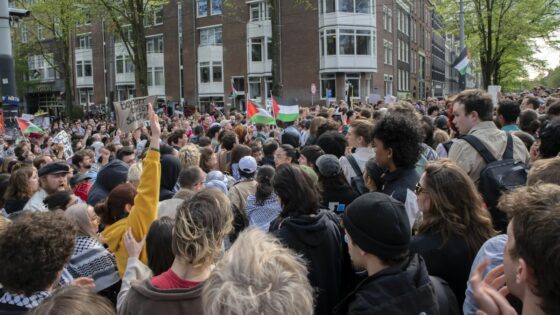
Van Teeffelen said SOMO is calling on the Dutch government to “stop using the EU as an excuse not to take serious action, and impose its own economic sanctions”. The cabinet has preferred to seek measures through Brussels rather than act alone, but EU states never agreed to adopt any. Foreign minister Caspar Veldkamp resigned last August after the cabinet refused to back further Dutch steps.
Measures could include “ending the tax treaty with Israel and stopping promotion of trade and investment through the Dutch embassy or the NFIA”, the government agency that has courted Israeli business from the Dutch embassy in Tel Aviv since 2012.
There is also a 1973 treaty that caps tax on payments such as interest and royalties flowing between the two countries, and ending it would not require EU approval.
A UN Commission of Inquiry concluded that genocidal acts are being committed in Gaza. In 2024, the International Court of Justice found Israel’s occupation of Palestinian territory unlawful and said states must not aid or assist the situation. Israel’s prime minister Benjamin Netanyahu is also the subject of an ICC arrest warrant over alleged war crimes and crimes against humanity.
“Under the genocide convention, the closer you are, the more responsibility you have to take measures,” Van Teeffelen continued. “Given this close investment relationship, and the importance of the Netherlands as a gateway for capital into and out of Israel, that puts a big responsibility on the Dutch government.”
SOMO is making no tax avoidance allegations against the companies named in the report, and found no unlawful activity by any of them in the Netherlands. Dutch corporate entities publish so little in their annual accounts, Van Teeffelen explained, that it is impossible to establish whether tax is actually being avoided or evaded.
There has been no government response to the findings so far, Van Teeffelen said.
Thank you for donating to DutchNews.nl.
We could not provide the Dutch News service, and keep it free of charge, without the generous support of our readers. Your donations allow us to report on issues you tell us matter, and provide you with a summary of the most important Dutch news each day.
Make a donation