New Rijksmuseum displays show personal stories from Holocaust
Senay Boztas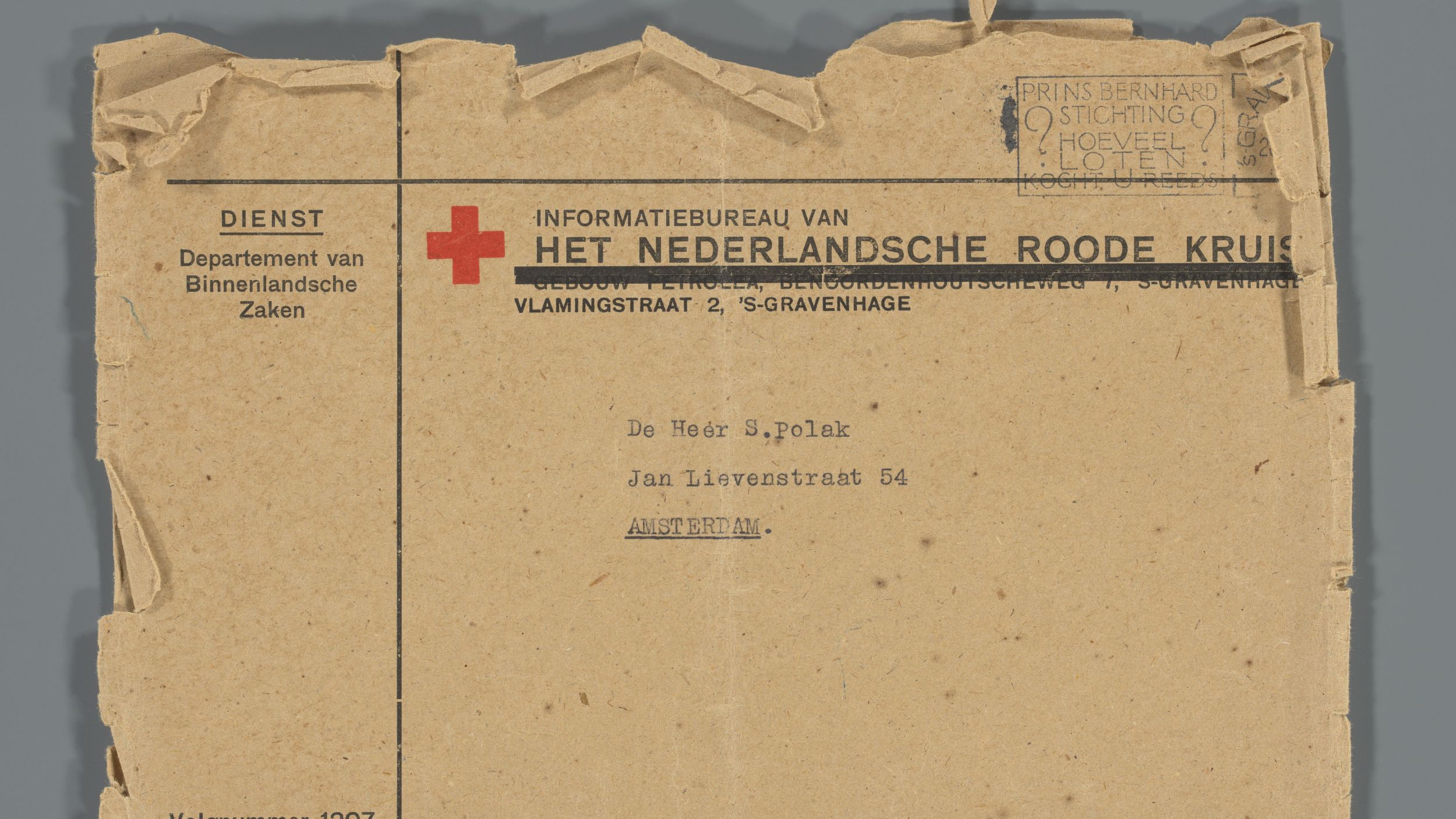
See more DutchNews articles in your Google search results
See more DutchNews articles in your Google search results
Add as a favourite source on Google Add DutchNews as a favourite source on GoogleIn stiff, bureaucratic language, a letter from the Red Cross confirms that Mirjam Polak-Rabbie was gassed in Auschwitz on February 12, 1943.
Like many Jewish victims of the Nazis, her life and her murder left little trace in the public records. But last year, her family placed a commemorative Stolperstein plaque in the pavement outside the 74-year-old’s last home. And now her family’s stories are part of a new exhibition at the Rijksmuseum.
For her great-granddaughter Deborah van Tiel, who donated a family archive including this letter to the Dutch national museum of art and history, a new display tells more than just personal stories.
“For nearly eighty years she was, in a sense, erased from history,” she said. “This is a tribute not only to her but also to her son, to my mother, and to all those whose lives were shaped by the war. As long as the Rijksmuseum exists, her story will continue to exist.”
On the top floor of the museum, three displays now cast a different light on the pre-war, Holocaust and post-war periods.
The first charts the rise of Nazi ideology and resistance to it, through political art between 1919 and 1939. A second uses objects to look at the experience of Jewish families in the Holocaust, alongside a chess set made by a German soldier and artist, glorifying the Nazi advance. A third looks at post-liberation objects.
Personal stories
The central display, unusually, focuses on personal stories thanks to two recent family donations, and this is where the letter from the Dutch Red Cross takes centre stage.
One case shows artefacts such as the expensive fake ID document that Mirjam’s son, Samuel Polak, used in order to survive the war – constantly at risk of being discovered and also endangering his non-Jewish wife and children.
In another is the official letter, sent in 1947, to formally tell him about his mother’s death – the only time his daughter Willy saw him cry. The family kept the letter, and its envelope, for three generations.
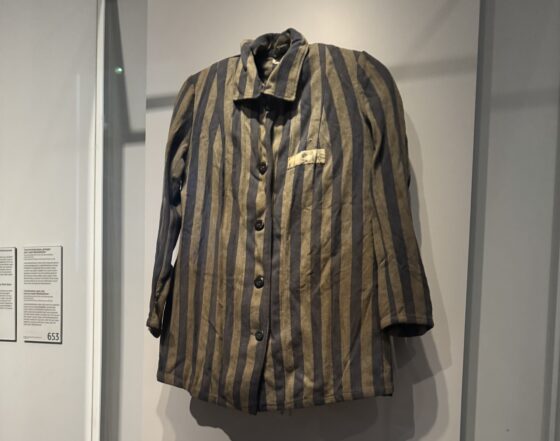
Another glass cabinet tells the story of the German-Jewish Wachenheimer family through a concentration camp coat worn by Isabel Wachenheimer. Reclaiming her identity from just a number, she sewed her own name into the collar and always kept this coat.
Recognition
Curator Mara Lagerweij previously worked on an exhibition about looted objects at the Jewish Museum in 2024 and was asked why this history was not represented at the Rijksmuseum. “It is a fair question,” she said. “We have done this research for a long time and we do find it important to keep paying attention to these stories.”
The question has helped inspire the Rijksmuseum to address the history more formally, including recognising forced sales such as the collection of German-Jewish woman Emma Budge, whose salt cellars by master silversmith Johannes Lutma were recently purchased from her heirs.
It is a way, says Lagerweij, of making numbers less abstract, when more than 102,000 Jewish, Sinti and Roma people from the Netherlands were murdered. Jewish people represented some 40% of estimated Dutch deaths worldwide during the Second World War; around three-quarters of the pre-war Jewish population was murdered, the highest rate in Western Europe.
“It is really moving and confrontational if you understand the suffering,” she said. “You come closer than the abstract numbers. What we hope to achieve with telling these personal stories is to make it as human as possible.”
Postwar silence
The specifically Jewish experience of occupation was initially unrecognised after the war, according to Kees Ribbens, senior researcher at the NIOD Institute for War, Holocaust and Genocide Studies. He sees the new Rijksmuseum display as part of a growing public openness to recognise past wrongs, including the fact that many looted Jewish objects have still not been returned.
“There is more room nowadays for all of the traumatic experiences during the war than directly after the liberation,” he said. “The idea then was that we had to look forward as a country – that we had all had an incredibly difficult period and that there shouldn’t be too much differentiation between different categories. But that was, of course, yet another injury to people who had gone through the Holocaust.”
It is particularly meaningful to use objects to tell Jewish stories, according to Raymund Schütz, senior researcher at The Hague’s municipal archive, because so many were lost, stolen or destroyed. “Objects restore names, faces, relationships and personal stories to people who were reduced by the Nazi regime to numbers and categories,” he said. “Personal objects symbolise not only the losses suffered but also the difficulties many survivors encountered in obtaining recognition, justice and the restoration of what had been taken.”
Remembrance
One display text explains what the Stolperstein – a replica of which is on show – meant to Mirjam Polak-Rabbie’s family. In 1939, Mirjam wrote in her granddaughter’s friendship book: “Don’t forget Grandma Mirjam.” Both the stone and the gift to the museum fulfil this wish.
“In a way, this donation feels like a small act of defiance against those who sought to erase Jewish lives and identities,” added Van Tiel. “As a great-granddaughter, this is incredibly meaningful.”
Lagerweij, whose job is also to research the Rijksmuseum’s collection, believes it is important to keep displaying such objects. “We have much more archival material in the depots or on loan to the Rijksmuseum, so the idea is to rotate that, perhaps with temporary exhibitions,” she said. “For Jewish people, it’s really important to keep mentioning the name. When you look online, there will always be Isabel Wachenheimer and her family. It’s a way of not being forgotten…but it relates to the national politics of remembrance.”
Dark sides
Ribbens, the historian, points out that this is also a function of a national history museum. “The Rijksmuseum tends to show off masterpieces but actually in the war and occupation period, you need to show the tragedy,” he said. “Because these are the dark sides of history that do not shine, but that also deserve attention.”
Lagerweij’s own grandfather was Jewish and put in a forced labour camp, while her great-grandmother was, like Mirjam Polak-Rabbie, taken away by the Dutch police.
“It’s always been part of my personal history,” she said. “But my motivation is to show what the process of dehumanisation can lead to, which is also translatable to other cultures and people. It’s a small attempt to show the consequences if we stop seeing each other.”
Thank you for donating to DutchNews.nl.
We could not provide the Dutch News service, and keep it free of charge, without the generous support of our readers. Your donations allow us to report on issues you tell us matter, and provide you with a summary of the most important Dutch news each day.
Make a donation