As World Refugee Day approaches, author Roy puts humanity first
Lauren Comiteau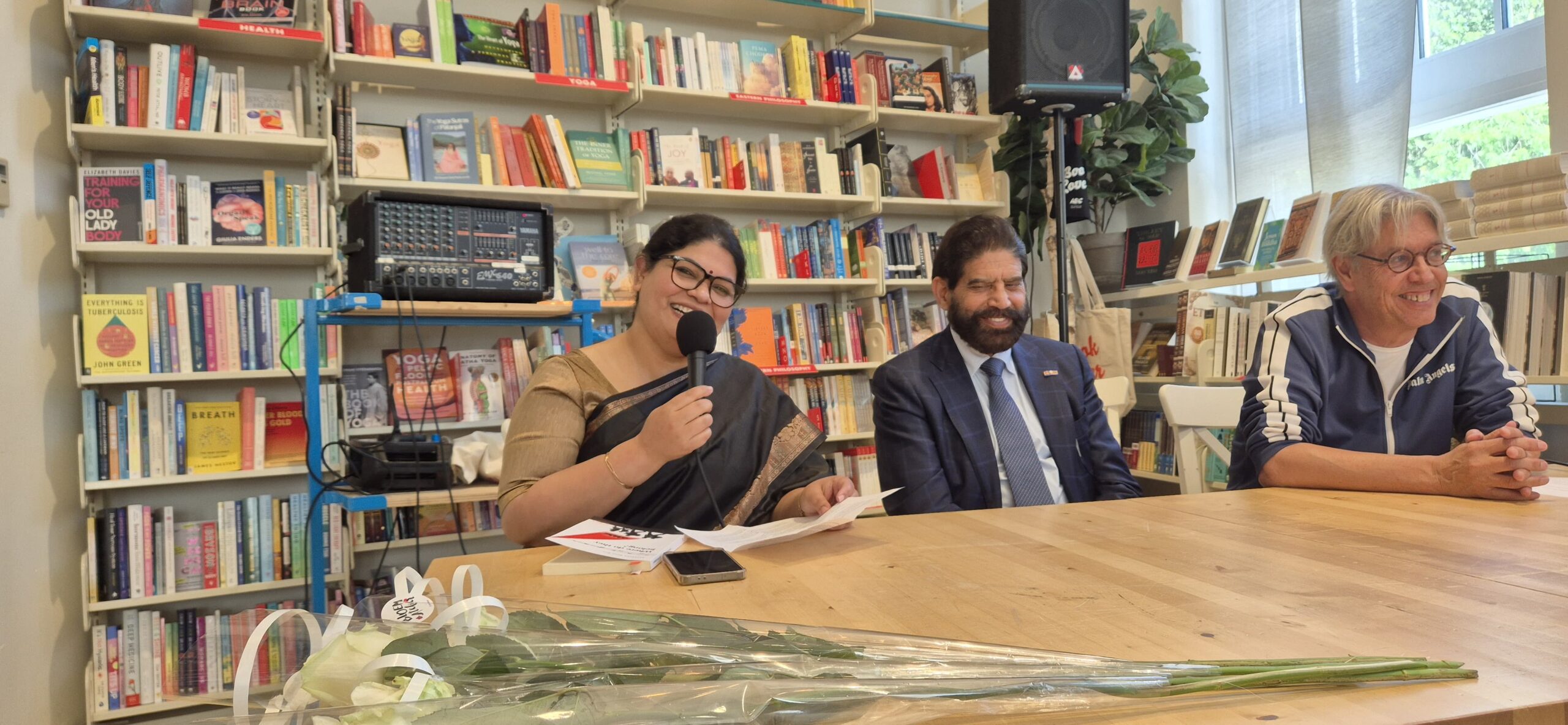
See more DutchNews articles in your Google search results
See more DutchNews articles in your Google search results
Add as a favourite source on Google Add DutchNews as a favourite source on GoogleSatarupa Bose Roy, author of the newly released Where do they belong?, recalled the moment she was first inspired to write this book seeking to give a human voice to often voiceless asylum seekers in the Netherlands.
She was watching a play at her daughter’s international school in Hilversum featuring Ukrainian refugees, one of whose mothers was sitting next to her. The two women broke into tears.
“She had left all her friends and family back home, and it made me think how they came with trauma and nothingness in search of peace and identity,” Roy remembered. “Are we able to give that to them?”
A migrant herself from India who followed her husband to the Netherlands some two decades ago, Roy said it took a language class to finally seal the deal.
“My class was made up mostly of refugees – from Afghanistan, Somalia and Lebanon,” she says. “I knew a woman who lost five children in the Syrian war. She had nothing, but she was trying to build a new life from this class.”
The teacher
Roy’s own experiences teaching English at the Dutch Royal Navy and big corporations like ING put her in touch with more asylum seekers, whose stories, she said, were worth sharing.
“At the big companies, you see cleaners. They’re all asylum seekers,” said Roy. “They’ve been given ID cards because we need our toilets cleaned. So they’re part of society, but they’re not. In the Netherlands, we talk about equality and parity, about no discrimination and racism. But is there really parity? Is there really no discrimination? That has to change.”
While Where do they belong? touches on the political aspects of the migrant debate, including the issuance of social security numbers (BSN), integration issues and Europe’s increasing anti-migrant sentiment, it stays true to its mission to move beyond the statistics and portray asylum seekers in all their humanity.
The asylum seeker
Taken from her interviews with asylum seekers she met via the Central Agency for the Reception of Asylum Seekers (COA), Roy’s book includes the stories of young women trying to find their places in an unfamiliar system, a defeated man about to be deported and a 27-year-old Afghan who reluctantly fled his home after the Taliban takeover and has been living in a Dutch asylum centre for over two years.
“I speak six languages and was working in Afghanistan,” said Arsalan (not his real name), who said he’s stuck in the waiting game like many migrants desperately anticipating their papers so they can work and begin their lives anew.
“Other people go to their homes at night, I go to my room,” he said. “I’m still grateful and trying to stay positive and hope for the future, but I can’t plan – not for today, not for tomorrow. It’s undeserving. I thought I should have done better things in my life at this age.”
Where do they belong? also features migrant success stories, including those of young women who managed to study in the Netherlands and become successful lawyers. It also contains a poem written by Arsalan, “The Road I Never Chose”, which reads in part:
Decisions hang, my fate unseen,
A life on pause-what might have been.
Yet still I walk, though worn and slow,
The road is mine, wherever I go.
For though I lost the life I planned,
I carry dreams in foreign sand.
Being included in the book has given asylum seekers a loud voice, he said. “We don’t meet many people.”
The call to action
Whether you’re a knowledge migrant like Roy or an asylum seeker, she dedicated her book to all people searching for their identity.
“I’m Indian at heart, but I also belong to the Netherlands,” Roy told a packed event this week at The American Book Center (ABC) in Amsterdam. “I was born in one place but built my identity in the other. This is not my story, but it could be.”
Immigration lawyer Jasbir Singh of the Dutch law firm Singh Lawyers joined Roy at ABC. He talked about the “arrogance of incidental birth” and the false distinction between economic and political refugees, “as if dying of hunger is less important than dying from war.”
He said the Netherlands has become less tolerant than when he first arrived on Dutch shores 53 years ago, but he urges people who want to take action to become aware, vote and treat all people equally.
“Even if you confront just one person, you can make a difference,” he said.
In a world of increasing nationalism and war, Roy said she realises her book goes against the prevailing winds. “It’s a little utopic, but we have to start somewhere,” she said. “It’s the need of the hour.”
World Refugee Day is held on June 20th, organised by the United Nations to celebrate and honour refugees around the world.
Thank you for donating to DutchNews.nl.
We could not provide the Dutch News service, and keep it free of charge, without the generous support of our readers. Your donations allow us to report on issues you tell us matter, and provide you with a summary of the most important Dutch news each day.
Make a donation