Weaving through time: Leiden’s Textile Research Centre
Brandon Hartley
What do a bizarre Santa Claus jumper from China, a 43,000 year old clump of mammoth hair, and a former pannekoekenhuysje have in common? They’re all things that will soon be located at the new home of the Textile Research Centre in Leiden.
The centre, or the TRC for short, is perhaps best described as a resource and educational foundation with a small museum tossed into the mix. It has served as a vital hub for textile researchers and students for over 30 years.
As the number of pieces in its collection crossed the 50,000 mark a few years ago, staff were faced with the immense task of finding and moving to a new place to store it all.
“Preparing 4,000 boxes of textiles, 500 boxes of books from the library, and everything else has been exhausting,” Gillian Vogelsang-Eastwood, the TRC’s director told Dutch News.
The origins of the centre date back to 1991 after Vogelsang-Eastwood relocated to the Netherlands to be with her husband following a stint working as a textile archaeologist in Egypt.
A series of lectures at Leiden University led her to an opportunity to serve as an honorary curator of textiles and dress at what is now the Wereldmuseum Leiden. This laid the groundwork for the non-profit foundation that would become the TRC.
Soon thereafter, she began receiving requests from students eager to research garments and other items in the collection. “They needed tactility, to touch and feel fabric to understand it,” she says.
Starting with pieces Vogelsang-Eastwood gathered from her travels around the world, she was soon inundated with donations from private collectors and others.
In 2009, the collection became too much for the museum to handle, so everything was moved into a former storefront that had served as, among other things, an ambulance station and coal merchant’s in prior incarnations. At the time, it seemed positively huge and big enough to accommodate the centre’s needs for decades to come.
By 2023, it was bursting at the seams. The time had come once again to find it another home.
Surprises around every corner
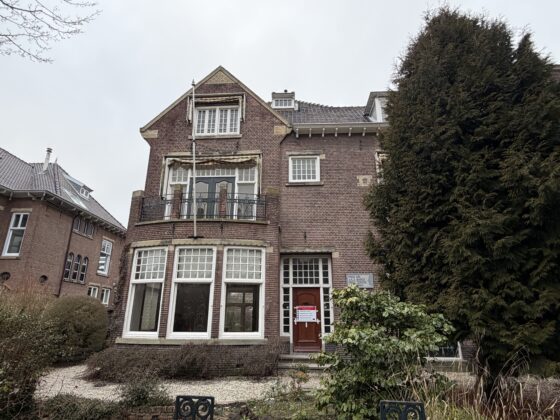
Boerhaavelaan 6, the house that will serve as the TRC’s next location, is rich with history and contains a few curiosities. For years, neighbours wondered what the elderly owner was keeping behind its closed doors. When the staff decided to open the house to the public for Monumentendag 2025, they figured they’d get a few dozen visitors at most. Over a thousand turned up.
The house was owned for over a century by the family of a professor who was jailed for publicly speaking out against the Nazis during World War II. They then seized the property and turned it into a headquarters for their operations in Leiden.
Doors on the ground floor still bear numbers painted on the frames to mark the Germans’ offices. The lawn in the garden still noticeably sags, likely because portions of their bunker are still under it.
Getting a move on
Vogelsang-Eastwood and Augusta de Gunzbourg, TRC’s head of exhibitions and education, are still concerned the new location wouldn’t be big enough to accommodate everything they hope to accomplish in the years ahead.
“In the last week alone, we were offered five collections,” Vogelsang-Eastwood says. A recent set of donations came from rooms that had been sealed up for decades in an old canal house in Amsterdam. Thrift stores contact the TRC’s staff when someone comes in with random clothing from their grandparents’ attic that could prove useful.
Despite the value of what they’re offered, the TRC regularly has to turn things down.
“We have to look at what we already have in the collection,” De Gunzbourg said. “If we have too many examples of something, that has to be given to charities or we contact other people who might be interested in them.”
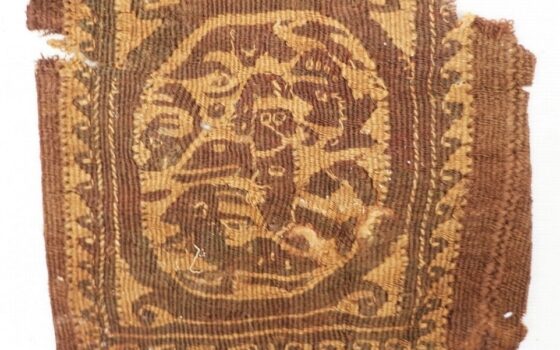
This is by no means a ‘dead collection’ and researchers are often allowed to see the pieces up close and personal. The TRC also gets requests from theatrical groups who use them to help design costumes.
A wide array
The collection is truly remarkable — everything from 18th century bicorn hats to a lace shawl once owned by queen Anna Pavlovna of the Netherlands. The oldest item is a 7,500 year old piece of fabric from what is now Turkey – the fifth oldest fabric known to exist in the world.
And there is the mammoth hair and Chinese jumper – a novelty piece featuring Santa Claus in a facemask while surrounded by gigantic Covid viruses.
“We go from prehistory to yesterday quite deliberately,” Vogelsang-Eastwood says.
The centre is free to visit but financial donations are welcome. Those interested in helping out can learn more on the TRC’s blog.
Thank you for donating to DutchNews.nl.
We could not provide the Dutch News service, and keep it free of charge, without the generous support of our readers. Your donations allow us to report on issues you tell us matter, and provide you with a summary of the most important Dutch news each day.
Make a donation