Local election watch: High tech Eindhoven is growing fast
Senay Boztas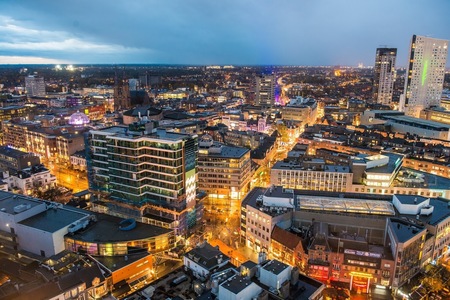
The Netherlands goes to the polls to vote for 342 local councils on March 18 and Dutch News is focusing on the campaigns in 10 towns and cities where most internationals live. Next up: Eindhoven.
Almost half of the residents of Eindhoven have foreign roots – and in this engine room of European technology, one of the big issues is how the region copes with growth, internationalisation and the pressure on facilities.
ASML has just been given the final go ahead to build a new campus, creating thousands more jobs – despite some concerns about the impact on the people already living in the region.
But while there is a level of antipathy towards wealthier “expats”, who buy 12% of houses, many Eindhoven councillors stress the positives of growth: a €2.5 billion government subsidy in public facilities to keep chip machine maker ASML expanding locally, plenty of jobs and a young, studenty population from all over the world.
Housing, unsurprisingly, is top of the agenda for all parties, with building lagging behind targets and one of the country’s most-pressurised markets. All parties want to build: some stress affordable and social housing, while others want to remove regulations to encourage more house building in general.
D66, the centre-left liberal party which won the national elections and is part of the city coalition, pledges to build 5,000 more houses a year, for all groups. “We have a high-tech tech economy, you need a lot of internationals to keep this industry going and we see economic growth more as an opportunity than a threat,” said Volkan Memiş, deputy leader.
“Through this growth, you can invest in houses, in equality of opportunity, in education but what is also important is to invest in culture: that is the key to create connections between Eindhovenaars and internationals who have come to Eindhoven.”
Candidates
The council is unusual in that several foreign-born locals are standing, some of them explicitly to ensure international residents get more of a voice. Miriam Frosi, head of the CDA group and a manager at the Rijkswaterstaat infrastructure organisation, was born in Italy.
She said the CDA – part of the current coalition – is a centrist party that stresses solidarity, including helping foreigners to re-root in Dutch society. In her eight years as a councillor, she said, she has made sure the council telephone line is also available in English, that voting documents (and its own programme) are translated, and that businesses are encouraged to sponsor language lessons through a Taalkracht language school initiative. “I’ve been an expat myself,” she said.
“I know how it is to leave your safe place, with friends and family and come to a completely new place with new customs, ideas, language – like an olive tree that used to be in the sun and has to get used to this rather colder ground. Connecting cultures is really important.”
Community
Building homes instead of complaining – niet mauwen maar bouwen – is the top ambition, including helping older people to downsize, plus reducing excess regulation, supporting new businesses and increasing safety and cleanliness on the streets. Chaitali Sengupta, an Indian woman who has lived in Eindhoven for two decades and runs a language institute, is standing at place 14 on the CDA list and will take part in an English-language debate on Friday 13.
“Eindhoven is ons thuis, our home,” she said. “This city has given us opportunities, community, a place to belong and I want to give back by contributing to an inclusive Eindhoven where everyone feels welcome, understood, appreciated.”

There are 168 nationalities in Eindhoven, 45.8% of the almost 250,000 residents come from abroad and the Indian-origin group is one of the largest. “Internationals are a visible group, not like when I came here 26 years back,” she said.
“At the same time, natives sometimes have the feeling that there are too many internationals in the city, there is concern about housing, health care, the shortage of staff in schools. But the municipality is welcoming candidates with an international background – that’s a positive trend.”
Less wealthy
Some parties focus on less wealthy residents. Left-wing and green party alliance GroenLinks-Pvda, part of the current council with 13 seats together, stresses green ambitions and support for low-income groups – including the many international students at Eindhoven University of Technology.
“I saw that international residents and students don’t feel so involved in local politics or know that they can vote so started to organise debates and activities for these target groups,” said local party leader Eva de Bruijn.
The party, which has translated its programme into Turkish and Arabic as well as English, stresses combating racism, promoting green space and sustainable housing, and investing in vulnerable neighbourhoods and accessible sporting facilities.
The VVD, currently in opposition, stresses entrepreneurship over big government, aims to spark house building by reducing the 85% affordable homes requirement, tackle crime and promote small business needs such as good (public) transport infrastructure.
Daniëlle Stijntjes, head of the local VVD, is an international entrepreneur who has lived in Turkey and in Spain and stresses the importance of language learning for newcomers. “At the moment you speak the language, you feel at home,” she said, from her own experience abroad.
“We need the talents, we want to welcome them, but at the same time, we also ask something back. Please, if you come here, try to understand how our culture is working, so we can communicate with each other.”
Although the VVD has not yet published its manifesto in other languages, it believes international “heads and hands” are vital in the Dutch workforce and has been campaigning in English, she added.
Participation
With more than 28,000 foreign-born voters – and only a 41% turnout in the last local elections – Eindhoven is making real efforts to inform everyone about their right to vote. The voting pass and candidate list are in both English and Dutch, there’s an English “information market” at the local library and a voting aid “stemwijzer” to help choose based on local issues you find important.
Sandra van de Maulengraaf, who works for the city council, said some people may have been put off from voting or not realise that they have the right. “This is the moment when you can have your say about the way forward for Eindhoven in the next four years,” she said. “Politics is closer to you than you might think…and there are a lot of ways to participate.”
- What you need to know about the local elections on March 18
- A quick guide to the biggest political parties
For Alina Totti, from Romania, at an electable spot 7 on the D66 list, getting involved is about representing international voices that are not always heard – like lonely trailing partners, desperate for a job, or migrant workers in precarious housing.
CBS figures show the international population of Eindhoven is younger than the Dutch average, typically without children, often new to the Netherlands, but with a normal range of disposable household income – mostly between €20,000 and €50,000, with slightly more lower income households (possibly students).
“I’m fascinated by the innovation here and I like to talk about how Eindhoven is influencing Brussels and Europe in general,” said Totti. “But at the same time, on my street, sometimes in the parking lot, you get people from Poland or Romania sleeping under a car because they’ve been let go and also kicked out of their accommodation. I like to talk about fairness and a more nuanced description of the internationals living in this area.”
Eindhoven key information
Current council executive: GroenLinks, CDA, PvdA and D66
How many seats on the council: 45
Total number of voters: 163,493
Number of EU citizens: 21,030
Non-EU citizens: 7,343
Local election information in English:
Six of the 13 incumbent parties have information in English.
GroenLinks/PvdA
D66
Partij voor de Dieren
CDA
Volt
Election events for internationals:
There is an English-language debate on March 13.
Additional research by Eden Tweedie
Thank you for donating to DutchNews.nl.
We could not provide the Dutch News service, and keep it free of charge, without the generous support of our readers. Your donations allow us to report on issues you tell us matter, and provide you with a summary of the most important Dutch news each day.
Make a donation