Local election watch: Close race and hard choices in Rotterdam
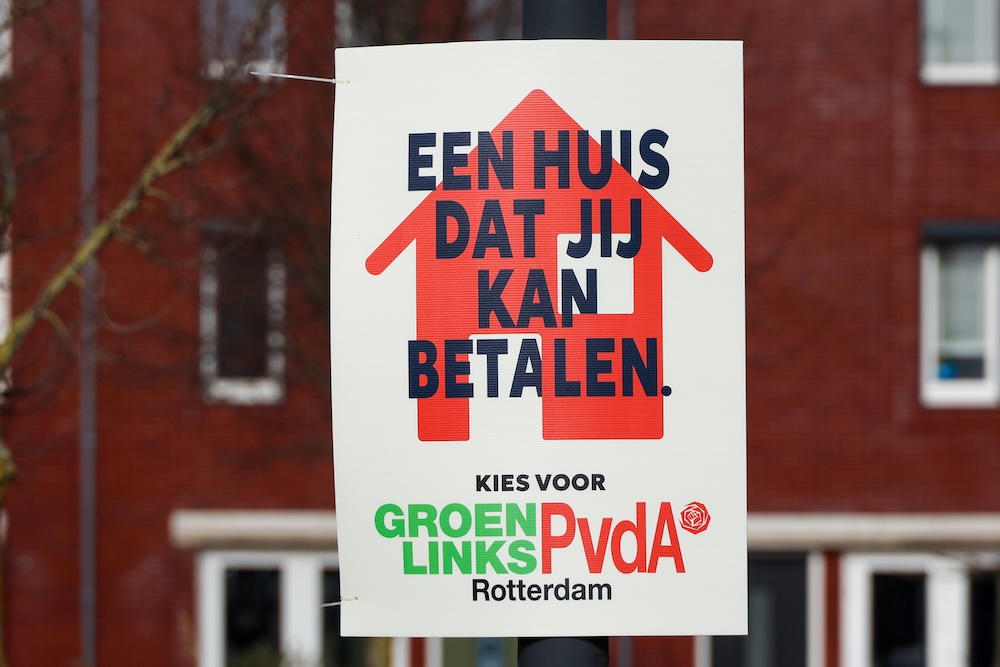
According to the opinion polls, Rotterdam is set to be one of the most fiercely contested municipalities in this year’s local elections, with three parties vying to become the largest group and take the initiative in forming the next coalition.
Leefbaar Rotterdam, the right-wing populist party founded by Pim Fortuyn in 2001, is currently the biggest with 10 of the 45 seats, having edged out GroenLinks–PvdA at the last election two years ago.
But polls suggest that the progressive-liberal D66 will run them both close, buoyed by the party’s success in the general election last October that resulted in national party leader Rob Jetten becoming prime minister.
The housing shortage is being felt in Rotterdam, as in the rest of the Netherlands, but the parties have widely different solutions for dealing with it, reflecting both their priorities and the diversity of a growing city where 44% of the population is of non-European origin.
The centre-left alliance of GL-PvdA, currently in opposition, wants 40% of new homes to be social rental housing, while the right-wing liberal VVD argues that the social rental sector is already strong enough and the city needs to concentrate on the mid-sector.
- What you need to know about the local elections on March 18
- A quick guide to the biggest political parties
Chantal Zeegers, a D66 candidate who was housing chief in the last council executive, says the city needs to build 100,000 houses by 2040 to accommodate a population growing by an average of 0.8% a year.
“We’ve reached our target for the last four years, but it’s very important that we keep going,” she says. “We see so many people looking for houses and it’s important for internationals as well, in the context of attracting businesses, that they can find somewhere to live.”
Leefbaar Rotterdam has not set percentage targets, but wants to build more homes for the middle classes. In keeping with the party’s campaign slogan of Rotterdammers Eerst – Rotterdammers First – Leefbaar also says newly settled refugees, known as statushouders, should no longer be prioritised for rental housing.
“We think it’s important that when houses become available, they go to Rotterdammers,” says lead candidate Ronald Buijt. “Giving statushouders priority means hundreds of homes are taken out of the market every year.”
The shortage of housing is also hindering Rotterdam’s ambitions to expand its student population. As housing director Zeegers allowed homeowners to rent out rooms to lodgers tax-free, which she says has helped to ease the pressure, but the city needs more purpose-built student housing in the long term.
Two years ago the city council and Delft University unveiled an ambitious plan to build a campus for 10,000 students in Rotterdam, with the personal backing of city mayor Carola Schouten, but the government in The Hague declined to co-fund the €2.8 billion project.
Zeegers, who is the lead candidate for D66, says her party sees housing as one element in improving the quality of life in the city, which also includes good education, amenities such as restaurants and cafés, green spaces and safe streets.
“We want to build good cycle routes and have fewer cars in the city centre, so there’s more space for greenery and terraces,” she says.
But the VVD and Leefbaar say the city needs to remain accessible by car and want to reverse some of the recent traffic reduction measures, such as limiting the approach to the Maastunnel to a single lane. “Symbolic measures like closing roads supposedly to cut emissions just lead to more traffic jams,” says Buijt.
Public safety is a key priority for all parties, but again the parties have different ideas about how to tackle it. Tim Versnel of the VVD says the city needs to “break the downward spiral” so that “parents can let their children play outside and women feel safe if they go out after dark.”
The VVD wants to install more security cameras in the city centre and hire 200 extra enforcement officers (boa’s), who would be armed and allowed to carry out preventive stop-and-search checks throughout the city.
Other parties are opposed to blanket stop-and-search, including GroenLinks-PvdA, who worry it will lead to ethnic profiling. Denk, a party that draws much of its support from migrant communities, is also concerned it will add to the stigma experienced by Muslims and other minority groups.
“It shouldn’t matter if someone’s an expat or a labour migrant, but unfortunately people are treated differently depending on their faith and their background,” says Denk councillor Serkan Soytekin.
Denk raised eyebrows by teaming up with the right-wing populist Leefbaar Rotterdam and the liberal parties VVD and D66 in the last coalition. Soytekin says power sharing has enabled his party to secure €20 million of investment in anti-poverty measures, such as extending public transport credits so all children under 18 can travel for free.
“We’re also very pleased to have invested more money in combating racism and discrimination and commemorating the history of colonialism and slavery,” he says.
Rotterdam is generally a welcoming place for international residents, Zeegers says, but it could do more to make its services more accessible. She has recorded a campaign video in English to explain how the voting system works, but says internationals often struggle to find their way to the city council’s help desk.
A case in point is the rents, where many newcomers are unaware that the council has significant enforcement powers, she says. “We have the affordable rent act, we can visit people’s houses and decide what is a fair rent. So it’s important that internationals know about that.”
Serkan Soytekin also says the council should do more to make landlords do not exploit the housing shortage to take advantage of vulnerable newcomers such as students and labour migrants.
“People who come here need to have a fair chance of getting a house and if that’s being abused, we should take a hard line against it and impose hefty fines,” he says.
Rotterdam has become a more attractive city for outsiders in recent decades, including international students, says Versnel, who grew up in the 1980s as the son of a German father.
“Around the turn of the century it was still a city that was talked about in terms of being on the wrong lists – most poverty, most crime, most ill health, you name it. Now it’s a city where people live well, but we shouldn’t become complacent, because some problems like the lack of public safety are getting worse and we need to stop that downward spiral.”
Economic competition
Versnel, who is alderman for work and income, says the city needs to improve its economic competitiveness by appealing to international companies, as well as cutting red tape and building more commercial space.
A decade ago the VVD was criticised for campaigning under the slogan “In Rotterdam we speak Dutch”, which was seen as insular and hostile to minority communities.
Now Versnel stresses the importance of making people who move to the city to live and work feel at home so they can “play their full part”.
“I know a lot of Rotterdammers struggle with speaking English, although the younger generation are much better at it, but I think we need to challenge ourselves to be more open,” he says. “In Rotterdam we speak Dutch and English. Those are our main languages.”
Rotterdam key information
Current council executive: Leefbaar Rotterdam, VVD, D66, DENK
How many seats on the council: 45
Total number of voters: 526,184
Number of international voters: 65,711
Local election information in English:
Nine of the 15 parties have online information available in English
GroenLinks
PvdA
D66
Volt
Partij voor de Dieren
BIJ1
ChristenUnie
SP
CDA
Additional research by Eden Tweedie
Thank you for donating to DutchNews.nl.
We could not provide the Dutch News service, and keep it free of charge, without the generous support of our readers. Your donations allow us to report on issues you tell us matter, and provide you with a summary of the most important Dutch news each day.
Make a donation