“Selling a house in NL is like living in two parallel worlds”
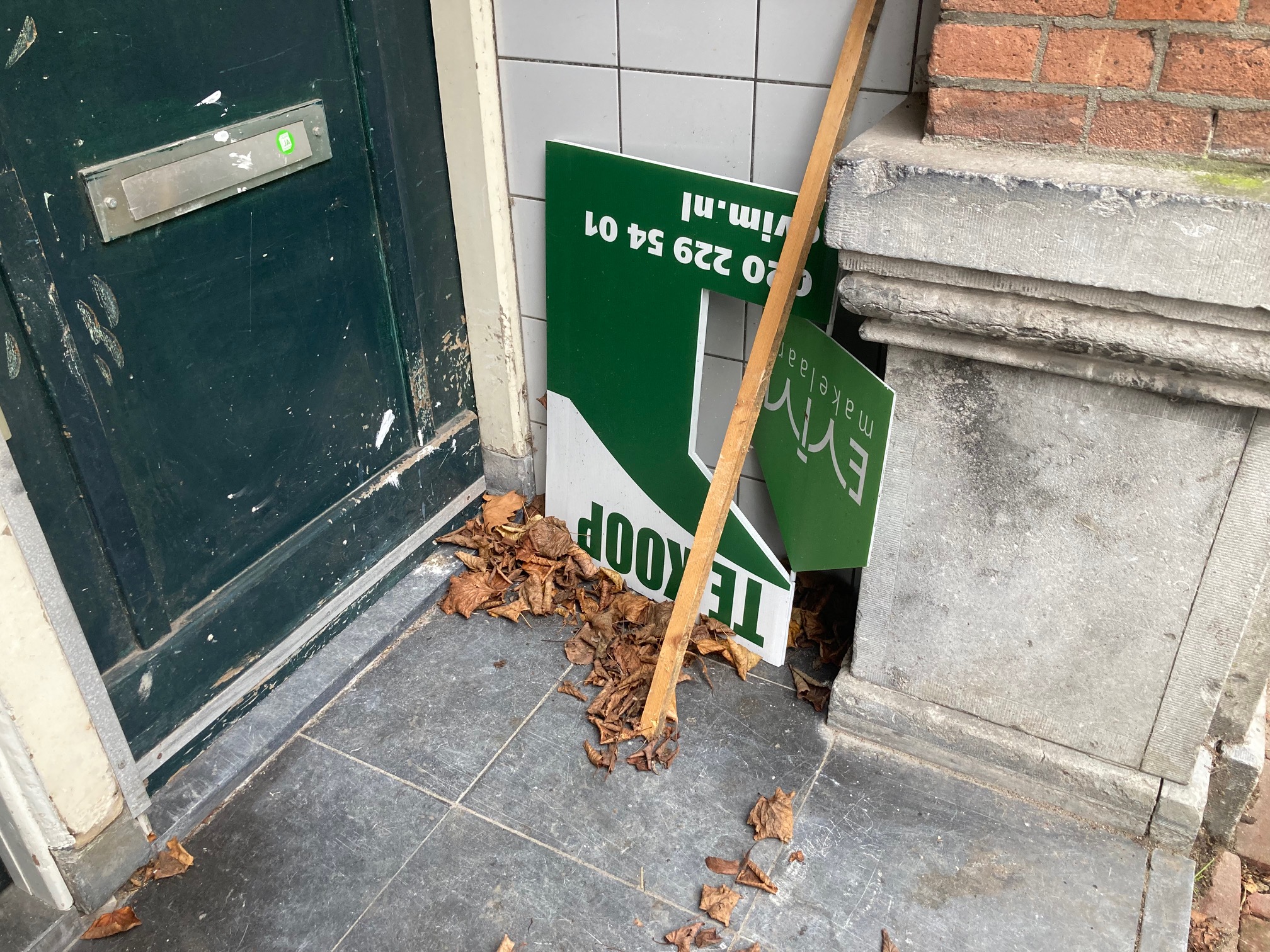
Buying and selling property in the Netherlands is not good for your blood pressure, says Steve White, after experiencing what it is really like to deal with estate agents, hidden fees and obsessions with being tidy.
My Dutch wife and I have recently forced ourselves through the property mangle by uprooting ourselves from the unstylish but modernist newtown of child-friendly Almere, to the ritzy international-lawyer-strewn boulevards of the nation’s political capital – The Hague.
When we sold our two bedroomed flat in unfashionable north London 25 years ago, before moving to Almere, the property market was not as brutish as it is now.
Our UK sale went ahead after a minimal amount of desultory Marrakech-market-type haggling, and we accepted an offer that was marginally less than the asking price. In today’s meaty Dutch market offering less than the asking price in property hot spots (propspots ) like Utrecht, Amsterdam, Rotterdam or The Hague, will have disbelieving sellers and their agents slapping their thighs in mirth whilst showing you the door.
“It’s a horrible system, this secret bidding thing. Why not just have an open, online auction? You bid up to your budget, and if it goes higher, that’s tough,” we ask. “This is the way we do it here,” we are told.
We bid on one apartment and later found out that our offer was third highest. The second highest bid was €1,000 more than ours. The ‘winning’ bid was €26,000 more. In theory, in an open auction, that buyer could have bid €1 more than the next highest bid and they would have had €25,999 in the bank for a new kitchen, which the place sorely needed.
When we started looking for apartments we were advised that we could never hope to buy a place in a propspot without hiring an aankoopmakelaar. They are hotshot agents of the property world. They will do all the donkey work regarding your move – check locations, accompany you on inspection tours, liaise with selling agents, check contracts, advise on the financials etc etc.
An aankoopmakelaar may suggest that you don’t bid an exact amount, on a property, say €500,000, but, €500,579. This random amount would just top a typical round figure bid. Why would a seller eschew an extra €579? That’s half a decent tumble dryer for their new place.
We saw this phenomenon many times and employed it ourselves with spectacular results. On the apartment we eventually purchased our extraneous amount of a few hundred euros actually related to the months of our daughters’ birthdays. The next highest bid, also with an obscure figure tagged on, was just €134 lower. I fear their kids were born in the wrong months.
As with any group of like minded professionals a quasi masonic aankoopmakelaar sub-culture exists in which the industry specialists trade rumours, gossip, chitchat, nudges, winks and inside information – all potentially indispensable knowledge that mere buyers could never be privvy to.
The bidding process itself is opaque, deadlines are there to be broken, nothing in the process is written in stone, let alone bricks, or indeed mortar. Money talks louder than deadlines. So, how much to overbid exactly?
At the time of writing, in three of the propspots, I would say this: Utrecht, 15-20%; The Hague, 10-15%; Almere, 7-10%. But the market changes quickly. I am not an aankoopmakelaar. You have not paid me three grand upfront (€3000). Please don’t quote me on this.
Celebrating
While we were smugly celebrating our unaided success we alas failed to hear an overexcited cash register clanging away in the background, a sound which accompanies every house sale – financial advisor (€3000); notaries (€2000); transfer tax (2% of the selling price; 0% on newbuilds); Taxatie report (€150-€775); and, for the linguistically challenged, translators (€250).
The euphoria of having eventually secured a place quickly dissipated when we realised we had to sell our own house, something that had, up to this point, apparently not crossed our minds.
And when you are selling a house in the Netherlands you suddenly start living in two parallel worlds: the world of your normal, messy life, juxtaposed alongside the wonderful white and empty world of Makelaarlaland.
Dutch makelaars (fee: 1-1.5% of the sale price) will suggest your chances of a sale improve if your house is white and empty. Unless you happen to live in a disused salt mine you are thus required to paint all the walls white and despatch all your personal belongings to the local dump.
Quick paint job
So we had to shape up. Apart from doing a rapid paint job and securing the mandatory energy rating (€280), we quickly learned that in Makelaarlaland these things are unwelcome: all personal items (especially family photos); unsightly kitchen equipment; old style pedestal toilets; untidy books; too much furniture; loose wires; cats; dead plants; colour; junk; mess.
When the makelaar came to inspect our house before the first viewings it echoed like a coroner’s corridor. We had thrown out enough noise-swallowing fabrics and furnishings to kit out a childs’ soft play area. Our house was no longer a house, but a commodity to sell.
We achieved our Makelaarlaland state of nirvana by ruthlessly editing our junk. We spent so much time at the local recycling centre we were given a loyalty card. And once we had de-cluttered, and tidied the place up it was time for our makelaar’s photographer (€650-€750) to take photographs using his Naomi-Campbell-Tardis Lens, a unique optical attachment which makes all houses look way more beautiful, and far bigger on the inside, than they actually are.
Viewing days
These photographs ended up on funda.nl, the pre-eminent Dutch website in the Netherlands for buying/selling/renting houses/apartments. And, of course, everything must remain tidy for at least 3-4 viewing days. In Makelaarlaland this means you are forever frantically secreting unsightly household objects, usually in places they don’t belong.
“Where are the toothbrush chargers?” I asked my wife. “Try the cupboard under the stairs,” she replied.
The problem with giving your house the mother of all spring cleans is that it suddenly becomes a decent place to live. I quite liked our house now. Do I really want to move?
More costs
But we had to. After all, we had a buyer and had booked a removal company (€1500-€3500, depending on distance, location, how much packing you want to do yourself etc).
So did my stress levels soar during this whole process? Absolutely. Especially during the bidding process for the houses we bought and sold. And I almost suffered a nervous breakdown when I quietly pondered that we were spending quite a few hundred thousand euros on a property that we had only seen twice, for 20 minutes each time.
To save you all locating the calculator app on your phone, and using an extremely broad emulsion brush, when you buy and sell a house in the region of €500,000 expect to pay anything between €25,000-€30,000 on all the extraneous expenses. Plus €579, of course.
Thank you for donating to DutchNews.nl.
We could not provide the Dutch News service, and keep it free of charge, without the generous support of our readers. Your donations allow us to report on issues you tell us matter, and provide you with a summary of the most important Dutch news each day.
Make a donation