Partner content
Newcomers face tougher Dutch standards, but some see opportunity
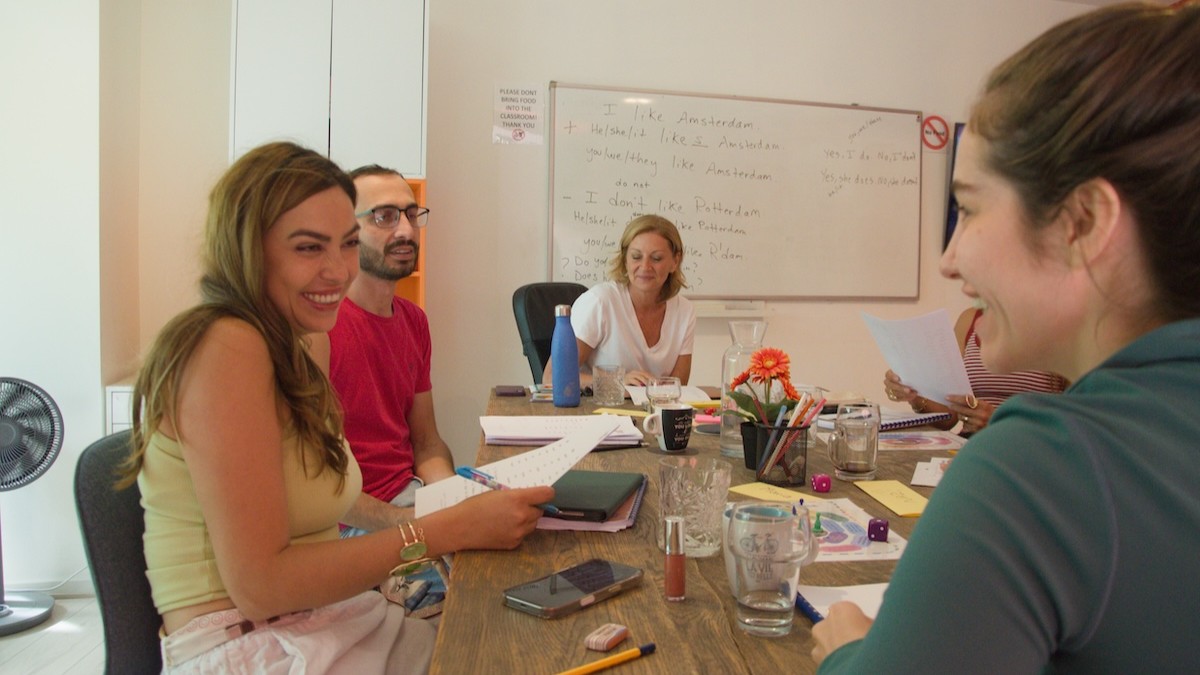
The Netherlands has raised the level of Dutch it expects from newcomers. For those who reach B1, the payoff goes beyond the paperwork. We spoke with experts at language school Language Corner about how the change in requirements is both a challenge and an opportunity for the international community.
Foreigners in the Netherlands are increasingly expected to speak Dutch at an intermediate level, as the government moves the standard from the basic A2 level to the more advanced B1.
For those who have to meet it, that means more time and money spent in the classroom. But learners and teachers say the higher level also brings people closer to working and living in the Netherlands.
For many, B1 is already the norm. Since January 1, 2022, people covered by the Civic Integration Act 2021 – mainly refugees and family members joining a partner here – have had to aim for B1 as part of their integration (inburgering) programme.
They can drop down to A2 only after making what the rules call “significant effort”, including 600 hours of lessons, according to municipal social services association Divosa.
Citizenship next
Citizenship is the next step; for now, people who want to naturalise can still do so with an A2 integration diploma. EU, EEA and Swiss nationals are largely exempt.
But the coalition of D66, the VVD and CDA has written a B1 requirement into its January coalition agreement, as part of a new route to citizenship for people on temporary residence permits.
The pledge is not new. The Rutte III, Rutte IV and Schoof cabinets all promised to raise the language bar for naturalisation to B1, and none put it into effect.
A2 versus B1
Both levels come from the Common European Framework of Reference for Languages, the scale used across Europe to measure language skills.
At A2, a “basic user” can handle simple, routine exchanges on familiar topics such as shopping, family and directions. At B1, an “independent user” can follow the main points of clear, standard speech about work, school and leisure, and deal with most everyday situations.
B1 speakers can also write simple connected texts, describe experiences and give reasons for their opinions. In practice, that means considerably more study than A2.
The opportunities
The rules are not the only reason to aim higher. Carlos Blasco, a design engineer from Valencia who has taken two courses at Amsterdam language school Language Corner, said he has noticed a shift in the job market.
“When I moved here three years ago, Dutch wasn’t really a requirement,” he said. “Nowadays, I see it in almost every job offer, so I think it makes professional sense to improve my Dutch.”
Blasco is now on a B1 course. He said he is learning to integrate into local life as much as for work.
Exam preparation
Language Corner, which teaches Dutch at two locations in Amsterdam and online, said many of its students switch to private lessons once they reach A2, to prepare for the B1 exams.
“Private lessons can really focus on an individual’s situation,” said Eric van Heesen of Language Corner. “In addition to prepping for the B1 exams, private lessons can help students improve where they need to, whether it’s speaking, listening or grammar.”
Teacher Daniel Vis said some students need B1 for a specific goal. “Some want to learn something specific, like studying for a master’s degree, in which case you need to be at the B1 level,” he said. “For such specifics, private lessons are better, because we do intensive course work with them.”
Edward Blake, an American experience designer, took group classes before moving to one-to-one lessons. “We had conversations, gave presentations, played games, wrote short papers and even watched a bit of broadcaster NPO,” he said.
Outside the classroom
The school also runs social gatherings outside lessons. Vis said he took his students to watch the recent eclipse, and they spoke Dutch together.
Blake, who said he chose classroom lessons over online or AI-based learning, is measuring his progress in daily life. “I’m faultless in an ice cream shop, but that skill has become less useful as the weather turns,” he said. “I try reading the Dutch newspapers but to mixed success (for now). I’m getting there.”
For Blasco, the turning point came at the Lowlands festival this summer, where there were few internationals. “I got to practise a lot of Dutch, and people – contrary to before – didn’t switch to English,” he said.
He said he can now follow conversations on the street and the news. “I might still miss some nuances, but that’ll come with time.”
If you’re just starting your language journey or need to pass your B1 levels, check out the Dutch course offerings at Language Corner.
Thank you for donating to DutchNews.nl.
We could not provide the Dutch News service, and keep it free of charge, without the generous support of our readers. Your donations allow us to report on issues you tell us matter, and provide you with a summary of the most important Dutch news each day.
Make a donation