“Many Dutch adults can only swim one stroke”
See more DutchNews articles in your Google search results
See more DutchNews articles in your Google search results
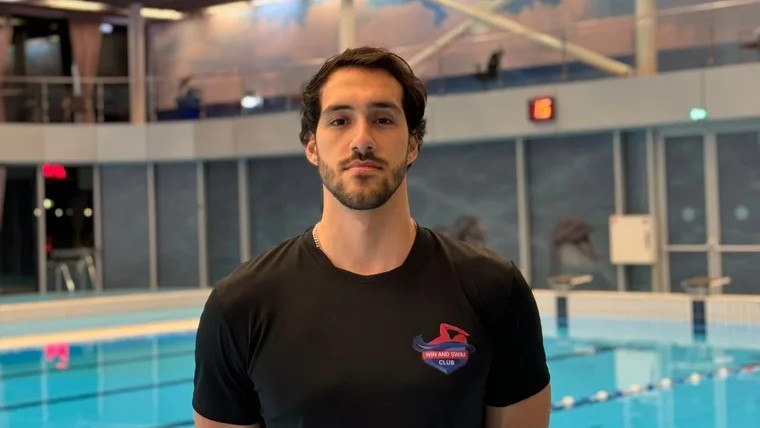
Add as a favourite source on Google Add DutchNews as a favourite source on GoogleFormer junior Romanian swimming champion Vlad Pațurcă moved to the Netherlands alone at the age of 21. Since then he’s founded his own swimming school in Amsterdam-Noord, where he now coaches hundreds of people. He idolises former Dutch Olympic swimming champions and dreams of one day building a squad of competitive swimmers.
How did you end up in the Netherlands?
I was a competitive swimmer in Romania, a freestyle sprinter, and swam for the youth national team. In 2021 I visited the Netherlands for the first time. The first city I saw wasn’t Amsterdam but Assen, in the north, and I fell for the Dutch way of life straight away: the quiet, the order, the way everything seemed designed for people. After that I didn’t want to be anywhere else.
I moved here at 21, with little work experience and no idea how Dutch law or business worked, and started coaching at a large adult swim club. In my first months there I saw how many adults wanted lessons. In 2024 I opened my own swim school, Win and Swim, in Amsterdam-Noord.
I paid for the first pool lane out of my own pocket and started with five or six swimmers. Since then we’ve taught more than 300 adults.
How do you describe yourself – an expat, lovepat, immigrant, international?
An international. The Netherlands is home now. Many of the people I teach are internationals too, often adults learning to swim from scratch.
How long do you plan to stay?
For good. I’ve built my business here and the plan is to grow it: more hours and new locations in Amsterdam first, then children’s lessons and other Dutch cities.
My dream is a performance squad, where I train competitive swimmers. Besides the swim school, I help companies with AI solutions.
Do you speak Dutch and how did you learn?
Not yet, and that’s a real challenge when you run a business. So far I’ve run Win and Swim almost entirely in English, and I’m learning Dutch now so I can take the business further.
In my first years here I did A1 through a free government course while I was living in Almere. After I moved to Amsterdam I wanted to continue with A2, but the free places go first to newcomers who need the lessons to integrate, for example to find work. I was already working and settled here, so I wasn’t in that group.
What’s your favourite Dutch thing?
My favourite thing is that things just work. When I opened my company, I entered my details online at the KVK chamber of commerce, went in the next day to sign and that was it: the company was open.
In Romania I’d have been running from one office to another, printing and signing papers. Here, sorting something out at the bank or the council is just as easy.
How Dutch have you become?
Dutch enough to appreciate the directness. People had told me the Dutch are cold. They’re not cold, just very direct, and at first that felt harsh. Now I value that nobody beats around the bush and nobody makes promises they don’t keep.
Which three Dutch people (dead or alive) would you most like to meet?
Pieter van den Hoogenband, Inge de Bruijn and Maarten van der Weijden. The first two are freestyle sprint legends, and sprint freestyle was my event. Van der Weijden came back from leukaemia to win Olympic open-water gold in 2008.
What’s your top tourist tip?
In summer, swim outdoors, but only at an official swimming spot (zwemlocatie), where the water quality is checked. Het Twiske, just north of Amsterdam-Noord, is a good one. And get on a bike. Here people of every age and every job cycle every day, and it’s the best way to see the country.
Tell us something surprising you’ve found out about the Netherlands.
Almost everyone here learned to swim as a child: around 94% of Dutch youngsters hold at least one swimming diploma. You’d expect a country of strong swimmers, but the reality is more nuanced. Many Dutch adults can only swim one stroke, breaststroke with the head out of the water.
The system teaches survival rather than swimming as a sport, which makes sense in a country full of canals. As a result, many Dutch adults come back to lessons later to learn freestyle and the other strokes.
If you had just 24 hours left in the Netherlands, what would you do?
Spend the day on my bike, out of the city, and end it with one last swim.
Vlad was speaking with Louis Gore-Langton
Thank you for donating to DutchNews.nl.
We could not provide the Dutch News service, and keep it free of charge, without the generous support of our readers. Your donations allow us to report on issues you tell us matter, and provide you with a summary of the most important Dutch news each day.
Make a donation