Partner content
Beyond profit: Why Dutch firms want impact-driven leaders

The Netherlands is fast becoming a testing ground for business that treats social and environmental impact as a measure of success. Its universities are adapting too: Nyenrode Business University runs an English-language Impact MBA, taught in Amsterdam and Breukelen, that builds sustainability into leadership training rather than setting it apart as a separate subject.
On April 8, 2026, the Netherlands’ National Coordinator for Sustainable Development Goals, Anna Pot, was handed a copy of the recently hashed out Impact Agenda 2030 at the Social Enterprise Government Congress in Nijmegen.
Described by the collaborative coalition of social entrepreneurs, foundations, municipal leaders, knowledge institutions and civil society initiatives that participated in its making as a “national framework for a future-proof and resilient economy”, the Impact Agenda aims to move the Dutch economy towards a system that has social and environmental metrics embedded in its core – not merely as an afterthought after profits are tallied.
“Impact is not a niche, it is a necessity,” is the message the Dutch Impact Ecosystem says it’s sending to national leaders. “And it has real economic value – for impact-driven organisations and traditional businesses alike.”
The agenda – which focusses on such themes as impact governance, procurement and finance, social and digital innovation and education and is in line with the European Commission’s Social Economy Action Plan – is just the latest national accomplishment that cements the Netherlands’ standing as a world leader in the move to sustainability and societal impact in its business sectors.
A recent report looking at how firms balance profit with impact found that of the 77 large companies the private-public consortium surveyed doing business in the Netherlands, the majority believe the initial regulatory hassles of the EU’s CSRD [Corporate Sustainability Reporting Directive] are overshadowed by its long-term benefits, all while helping their businesses.
The report found that “Dutch companies are leading the way in integrating impact governance into their strategies.”
Learning laboratory
The country’s strong collaborations between businesses, government and knowledge institutions create an environment of innovation and entrepreneurship that has led professionals worldwide to increasingly choose the Netherlands to learn how businesses can create both commercial success and positive societal change.
In the Netherlands’ dynamic Dutch business ecosystem, leaders have the opportunity to put theory into practice.
New leaders
Driven by European sustainability regulations, evolving investor expectations, rapid technological developments such as AI and growing stakeholder expectations, companies today are looking for leaders who can navigate complexity rather than optimize a single bottom line.
And the country’s universities and knowledge institutions are keeping pace. Nyenrode Business University, with locations in Amsterdam and Breukelen, offers an English-language MBA program focused on creating the future leaders of this brave new business world.
Its Impact MBA was designed as a response to changing employer needs rather than as a traditional MBA program. Instead of teaching sustainability as a standalone subject, the curriculum integrates leadership, digital transformation and sustainability throughout the learning experience.
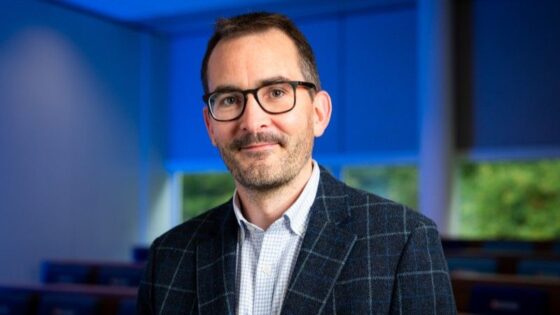
“Sustainability transitions involve long-term developments with significant short-term implications for organizations,” says Prof. Dr. Nicolas Chevrollier, Professor of Sustainability Transitions and designer of the Impact MBA. “This requires new competences, new collaborations and sometimes entirely new business models.”
Chevrollier emphasises that organizations cannot solve today’s challenges independently. Businesses increasingly operate within ecosystems involving governments, knowledge institutions, investors and civil society, meaning effective leadership depends on building partnerships rather than optimising organisations in isolation.
“Many organisations suffer from tunnel vision,” he says. “To truly innovate, leaders need to broaden their perspective.”
The Impact MBA gives tomorrow’s leaders a chance to do just that: innovation and a systems-thinking approach are embedded in its curriculum, creating business trailblazers who can balance financial and societal objectives while thinking across entire systems instead of just individual organizations.
Are you looking to develop the new capabilities needed for the profound transformations taking place in today’s business world? Then check out Nyenrode ‘s Impact MBA, available both part-time and full-time, or join one of their on-campus and online events to discover more.
Thank you for donating to DutchNews.nl.
We could not provide the Dutch News service, and keep it free of charge, without the generous support of our readers. Your donations allow us to report on issues you tell us matter, and provide you with a summary of the most important Dutch news each day.
Make a donation