First Dutch quantum computer comes with message for The Hague
Louis Gore-Langton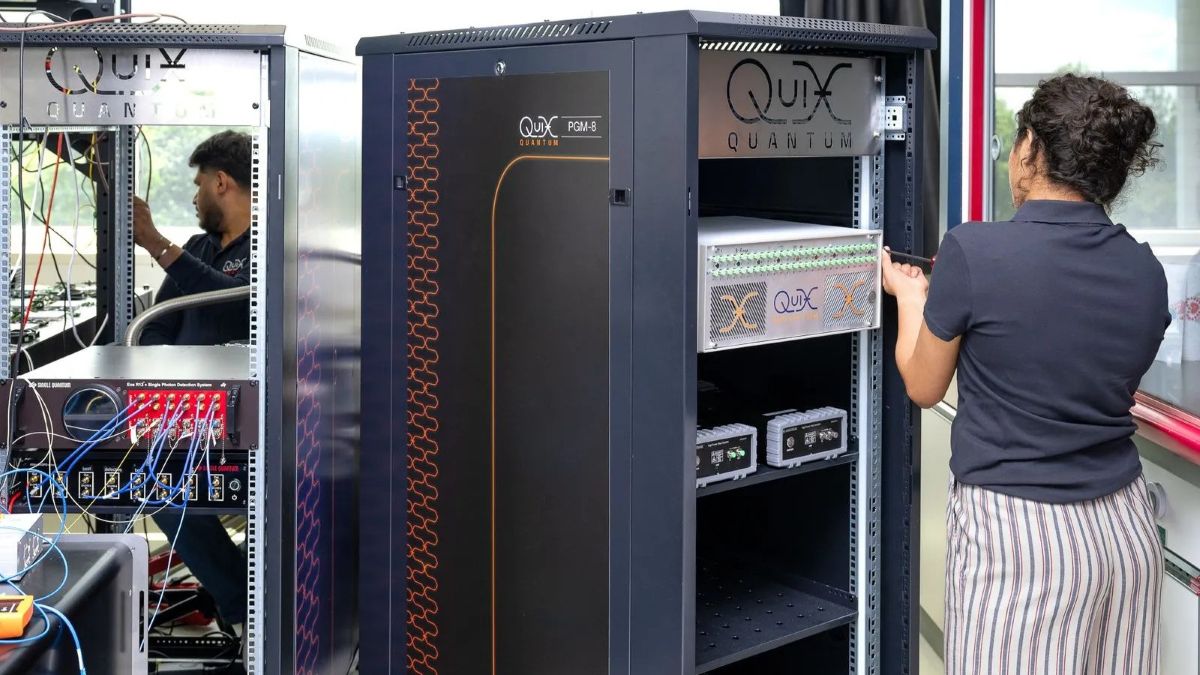
See more DutchNews articles in your Google search results
See more DutchNews articles in your Google search results
Add as a favourite source on Google Add DutchNews as a favourite source on GoogleThe first complete quantum computer built by a Dutch company has been delivered to a customer, but that customer is a German state institute, and the company behind it says the Netherlands needs to act faster to support its own tech industry.
Quix Quantum, a University of Twente spin-off based in Enschede, has handed over the machine to the German aerospace institute DLR after almost four years of development, the Financieele Dagblad reported on Tuesday. DLR will test over the coming months whether it performs as intended.
The fact that a foreign state institute became the first customer is “both a strong endorsement and a clear signal”, Quix’s chief commercial officer Robin Wittland told DutchNews. The Netherlands has exceptional capabilities, he said, “but it must act faster to convert them into industrial leadership… it needs to accelerate procurement, investment and industrial deployment.”
Wittland wants the Dutch state to become a “launching customer” for its own technology, pointing to Germany’s approach: the DLR programme pays start-ups to build quantum computers, then subjects the machines to rigorous testing.
Computing with light
Quantum computers exploit the strange behaviour of subatomic particles to perform calculations far beyond the reach of ordinary computers, with potential breakthroughs in fields such as drug research and battery materials.
Quix’s machines compute using particles of light, which means they work largely at room temperature, while most rivals’ designs must be cooled to close to absolute zero.
The technology is still in its early stages, and Wittland is frank about what the new machine, named Carina, cannot yet do. It is yet not intended to beat classical computers on practical industrial problems, he said.
He compares it to the first transistors, which did not immediately outperform the computers of their day. “Their significance was that they introduced an architecture that could be manufactured, integrated and scaled,” he said. Carina, he explained, “is not the final destination, but it is a meaningful step” towards industrial technology.
Taking on the giants
Quix’s rivals include big American tech companies like Google and IBM, but Wittland argues that young deep-tech firms “do not win through scale at the beginning” – they win by picking the right architecture and solving hard engineering problems faster.
The DLR project is worth around €14 million, although Wittland describes that as the value of a development programme rather than the price of a finished product.
Philippe Bouyer, director of Dutch quantum sector organisation QDNL, told the FD that successful validation by DLR would be “powerful proof that Europe, and especially the Netherlands, can deliver complete quantum systems”.
The countries that buy quantum technology early, Wittland said, “will not only buy technology; they will help build the industries around it”.
Thank you for donating to DutchNews.nl.
We could not provide the Dutch News service, and keep it free of charge, without the generous support of our readers. Your donations allow us to report on issues you tell us matter, and provide you with a summary of the most important Dutch news each day.
Make a donation