Court backs council over asylum shelter as overcrowding worsens
See more DutchNews articles in your Google search results
See more DutchNews articles in your Google search results
Add as a favourite source on Google Add DutchNews as a favourite source on GoogleA temporary refuge for 70 asylum seekers that has been the focus of violent protests for several weeks will remain open after a court dismissed an objection by a group of local residents and businesses.
The former town hall building in Loosdrecht, Noord-Holland province, has been converted to a shelter for asylum seekers as part of a nationwide plan to ease pressure on the overcrowded main reception centre in Ter Apel, Groningen.
The municipal council in Wijdemeren said last month that some 70 lone male refugees will be house in the building until November 1, sparking an angry backlash and demonstrations that led to violence, with fireworks thrown at police and bushes set on fire outside the building.
A group of eight business owners and five residents, under the name of Burgergroep Loosdrecht, petitioned the district court for Midden-Nederland to ban the council from using the building as a refugee facility because the council had not followed the proper planning and consultation procedures.
Lawyer Redmer Keizer said: “The rioting and disorder that has arisen has had a huge impact on my clients: it’s become a real war zone.”
But the court dismissed the claim, ruling that the need to accommodate asylum seekers and address the national shortage of places outweighed the objections of local residents.
“Organised” riots
A spokesman for the council welcomed the decision, adding: “What is important now is that we look forward and keep holding talks with our residents to ensure the temporary emergency accommodation works well.”
Riots have broken out at several other locations that have been earmarked as shelters for asylum seekers in recent weeks in places such as IJsselstein, Apeldoorn and Den Bosch, leading to claims that the violence has been orchestrated and co-ordinated by far-right groups.
More than 40% of people arrested at anti-asylum protests had registered addresses outside the municipality where they were held. Asylum minister Bart van den Brink has asked the security service AIVD to investigate whether “organised activity” is behind the riots.
Van den Brink has said he will use his powers under the so-called “spreading law”, which requires all councils to take in a proportionate share of asylum seekers, if they fail to come up with their own solutions.
Shortage of places
At the moment fewer than 100 of the 342 municipalities are complying with their obligations, while there is a shortage of 40,000 beds.
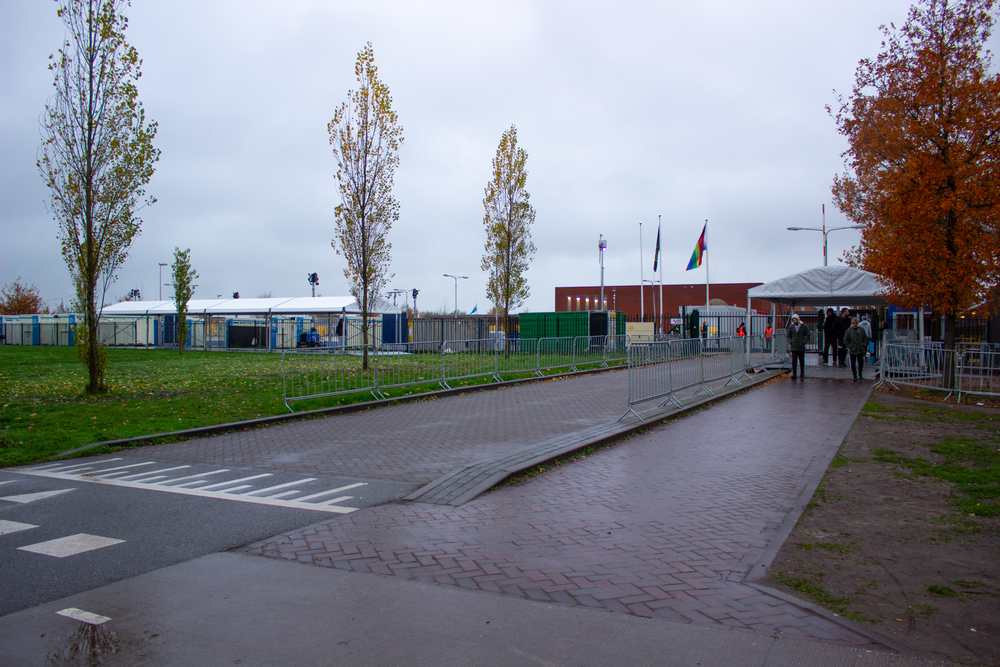
Meanwhile, the reception centre in Ter Apel has started to turn away some asylum seekers because of lack of space. The accommodation agency COA said it was prioritising the most vulnerable, while others were either given temporary shelter at a nearby centre in Stadskanaal or left to sleep on the grass outside.
The centre has a capacity of 2,000 people, but last week more than 2,300 were sleeping in the building, the highest number since September 2024.
The COA has to pay a fine of €50,000 to the local council in Westerwolde for every night that it exceeds the limit. It says part of the problem is that 19,000 people who have been granted asylum are still living in temporary shelters because of a lack of suitable housing.
Thank you for donating to DutchNews.nl.
We could not provide the Dutch News service, and keep it free of charge, without the generous support of our readers. Your donations allow us to report on issues you tell us matter, and provide you with a summary of the most important Dutch news each day.
Make a donation