Greener greenery? Amsterdam decides to ditch pesticides
Senay Boztas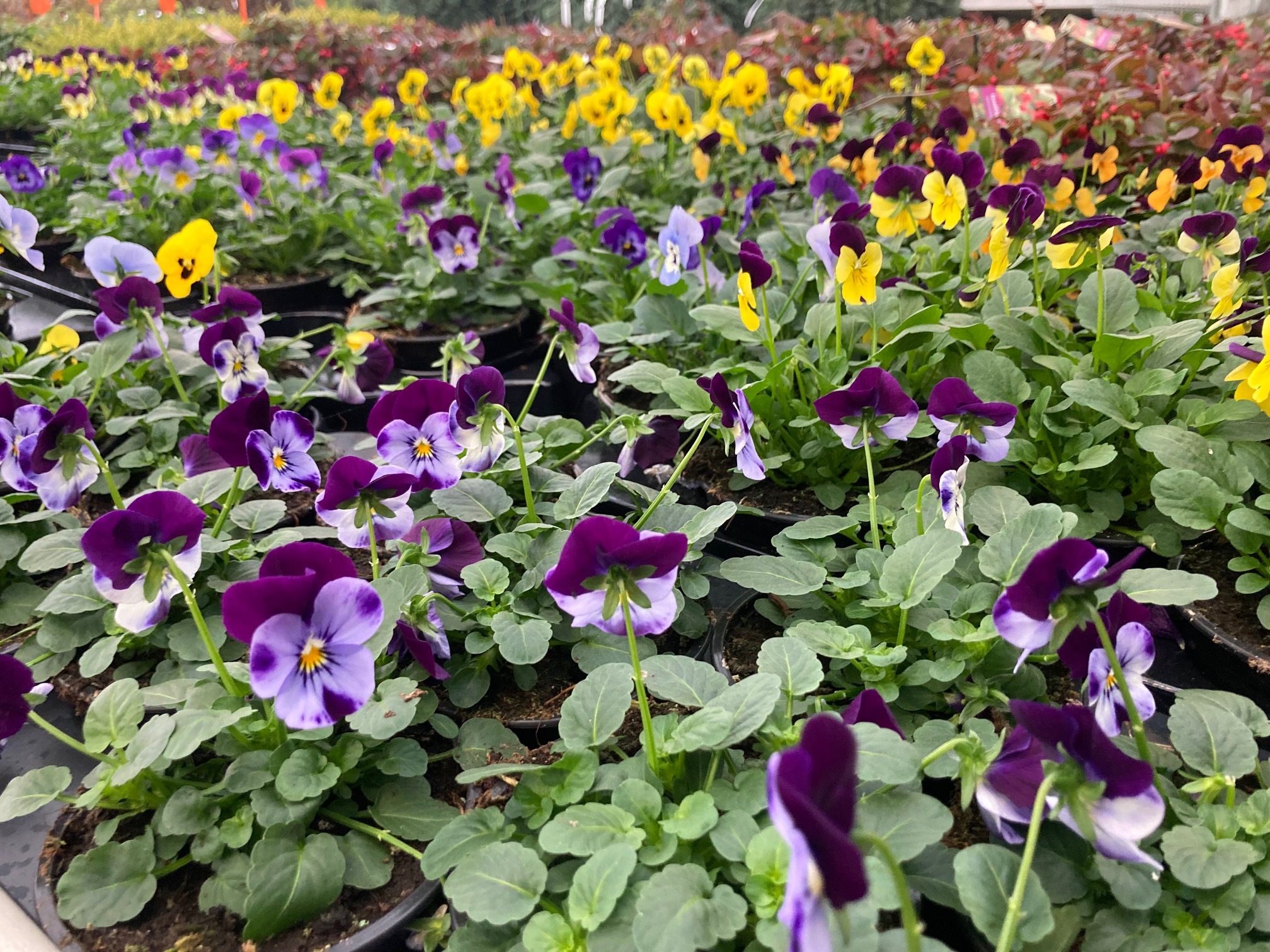
Amsterdam city council has decided to buy only organic plants for its parks, offices and open spaces, amid rising concerns about the effects of pesticides on residents, insects and bees.
The city, first in the Netherlands to go pesticide-free, has 70,000 m² of public space filled with flower boxes, trees and vegetation. It announced in January it will from now on procure only “poison-free” plants.
“I am very worried about biodiversity in the city, and the idea that toxins could eventually end up in the ground and on people and animals,” said Melanie van der Horst, head of open space and greenery. “It is taking too long for the market to go toxin-free. So I thought: from now on, we will make our own agreements with dealers.”
Around 28,000 hectares of land in the Netherlands are used to grow flowers, plants and bulbs – half of them for tulip-growing. According to Dutch statistics office CBS, some seven billion bulbs are exported each year, a trade worth more than €1 billion in 2022.
Although the amount of pesticides used to control fungi, weeds and insects in agriculture has dropped by a fifth since 2020, more than half of the total goes on just two crops: potatoes and lilies.
Scrutiny is increasing in particular around the lily trade, with a group of residents in Limburg winning an injunction to prevent a local grower from planting them last year. The court found that there was “a real chance of damage” for the health of residents and their children.
Lily field
Marijn Kingma, the lawyer at Höcker Advocaten who is representing the group, said that when residents read that the public health institute RIVM advises children and animals to be kept indoors, windows to be shut and laundry to be taken down during pesticide spraying, they became worried.
“One of my clients called the GGD [health service] to ask: ‘What happens when the farmer goes away? Do I have to clean the slide in my garden?’”
They could not give her an answer. “She said: ‘this is crazy because they are telling me that there’s such a risk I have to take my children inside. But then after that, when is it safe again? And is it ever safe again?’”
Reading scientific articles, news reports and warnings from some specialists, they became concerned about potential neurological effects that have not yet been tested. Professor Bas Bloem, neurologist at the Radboud University Medical Center, believes that – particularly with “luxury products” such as flowers – commonly used weed killers such as glyphosate should be banned until proven safe.
“There is 40 years of research with converging evidence from epidemiology, toxicology, animal studies, and other types of research that consistently indicates that pesticides are one of the contributing factors that may cause Parkinson’s disease,” he told Dutch News. “Pesticides are not the only cause of Parkinson’s, but there is widespread consensus that they are among the various environmental factors that jointly contribute to causing this disease.”
It is, he said, the world’s fastest-growing neurodegenerative condition. “This is not to say that the currently used pesticides are a definite cause of Parkinson’s but they have never been proven to be safe,” he said.
Densely-populated
According to investigative journalists from the Zembla programme Ton van der Ham and Vincent Harmsen, a million people in the densely-populated Netherlands live within 250 metres of a field.
Hans van Boven, a spokesman for government’s pesticide testing authority, Ctgb, told Dutch News there is currently a gap in the testing. “At the moment, we judge as many aspects as possible, and when we are allowing a substance, we look at whether neurological effects are visible,” he said.
“Regarding the risk of Parkinson’s, we don’t look at this specifically. We want to do this but we need a European framework, so we have submitted a request to the European Food Safety Authority to develop one.”
He said, however, that while its stance was that all products it has tested are safe to use, local councils are free to make their own rulings. “There can be other reasons why for example a municipality or a province doesn’t want bulb growing,” he said.
“This isn’t so much about the safe use of substances but you could say – for political reasons – that you do not want any chemical pesticides to be used within 50 metres of a residential area or within 50 metres of a school playground. That’s a political judgement rather than a toxicological one. And governments can make it.”
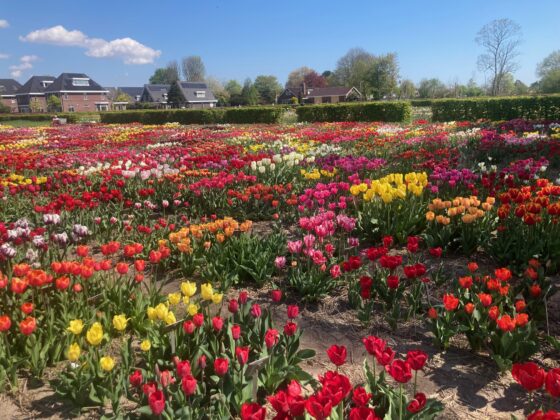
Keukenhof
As spring approaches, and the new flowers start to emerge, various councils have concerns about pesticide use. The Rijnland water board is investigating surface waters for banned pesticides in the so-called Bollenstreek bulb growing area, after questions at local council level in Lisse.
Floral tourist attraction the Keukenhof – which reported €14.7 million in pre-tax profit in its 2024 accounts – is sponsoring a €100,000 Wageningen University & Research study into developing virus-free and more resistant bulbs. It did not answer Dutch News’s specific questions about what pesticides it uses, and in what quantities, saying this varies according to the weather and that it reduced pesticide usage in 2024.
Spokeswoman Martine de Ridder told Dutch News that it is working to switch to organic-only crop protection products as quickly as possible. “Keukenhof uses only permitted products that meet the strictest standards,” she said in an email.
“Keukenhof holds an internationally recognised MPS-A+ certification, which means our environmental impact is kept as low as possible. During the visiting season we use biological crop-protection products.”
Positive choice
Creating a market for organic flower farming – and accepting that some plants might not survive all weathers – is, according to some, part of the challenge. Kingma, whose residents’ case has now gone to the Supreme Court, pointed out that most Dutch flower and bulb farming is for export but welcomed Amsterdam’s decision.
“It won’t really put a dent in the demand, but I think it is still very useful: organically-grown flowers are only a small percentage of the entire market right now and [it is good to] increase that demand because farmers are saying it’s expensive to grow flowers without pesticides,” she said.
Locals win right to know which pesticides are used near them
Warning about cut flower growers flouting regulations
Bloem said Amsterdam’s approach was “welcome” with health in mind. “This step is in line with the precautionary principle, where the health of citizens should receive absolute priority over the use of pesticides to safeguard the health of plants, flowers, or trees,” he told Dutch News.
A couple of Amsterdam’s plants and flowers may change a little, said Van der Horst; others will be grown organically in its plant nursery, run by social enterprise Pantar. This year’s tulip festival will also be all-organic.
“I don’t think it’s my job to make big statements,” she said. “It’s my job to show that as a city we want to give a good example, to inspire others and increase awareness. And I think this is a very positive way to do it.”
Thank you for donating to DutchNews.nl.
We could not provide the Dutch News service, and keep it free of charge, without the generous support of our readers. Your donations allow us to report on issues you tell us matter, and provide you with a summary of the most important Dutch news each day.
Make a donation