Not a load of bull: Classic painting once showed larger genitals
Senay Boztas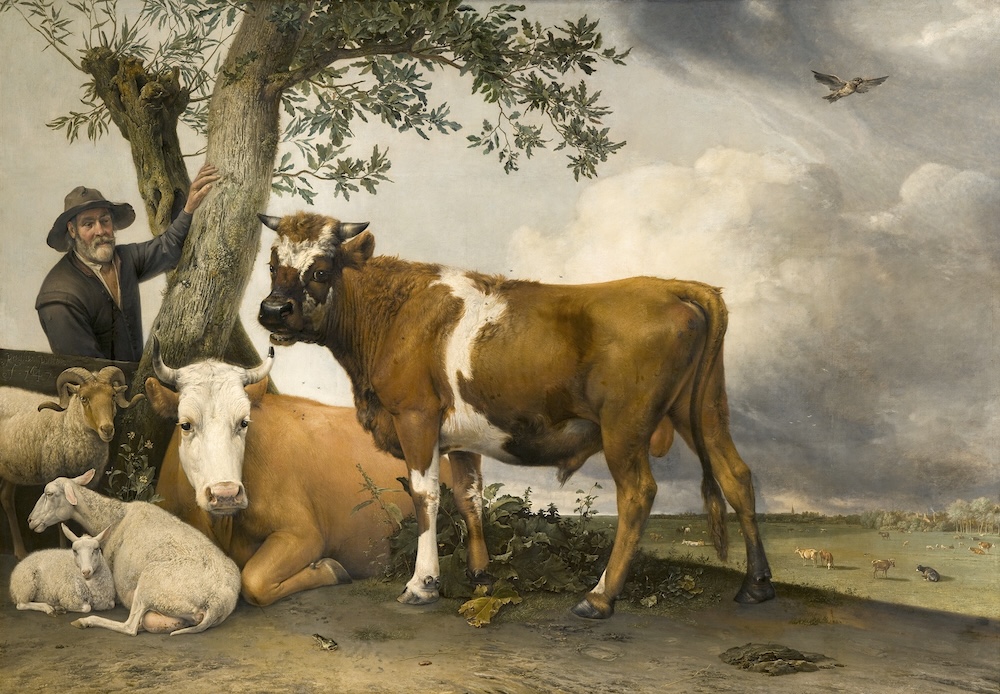
When restorers started to strip away the layers of a 17th century painting called The Bull – a national treasure once looted by Napoleonic troops – they did not know what to expect.
But the last thing they had anticipated was the original underpainting by the 22-year-old artist, Paulus Potter. Underneath the top layer of paint, on a much smaller original canvas, his bull had dramatically larger testicles.
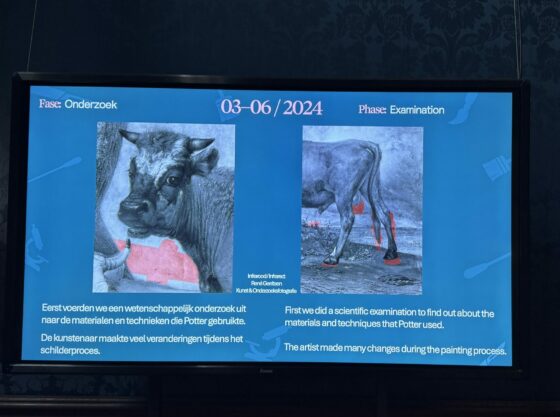
“During the technical examination, we found that Potter made lots and lots of changes as he worked, and not only to the composition. He literally enlarged the canvas,” said Abbie Vandivere, one of the paintings conservators at the Mauritshuis in The Hague.
“It started as a smaller composition, just a painting of a bull, maybe with the cow in it. When he made the composition bigger, he made a ton of changes, also to parts of the bull’s anatomy…His balls were bigger and lower.”
Although this was a “big surprise” to the painting experts, they could only guess whether it was a correction or the result of the young painter sketching from real life in the fields – but then modifying his design to the national sensibilities of 1647.
“We have consulted quite a few cow experts and there are definitely breeds of cow that have giant, pendulous testicles,” she said. “It also depends on the age of the bull: of course, when they are younger, they’re still forming, and this is supposed to portray a young bull.”
Jolijn Schilder, paintings conservator, said there was other evidence to suggest that the raw size of Potter’s subject could have been found too shocking. “He had an etching of a pissing cow that created a bit of a controversy,” she said.
“It is assumed that he got that [commission] from Amalia van Solms, princess of Orange, and he was supposed to create a mantelpiece for one of the palaces. It was turned down by her because she thought it was too filthy a subject to show a pissing cow above her mantelpiece.”
Napoleon
The restoration of the gigantic, 1647 painting has taken place behind glass during 18 months in an entire gallery of the Mauritshuis in The Hague. It is part of a project to find out more about a talented artist who died of tuberculosis at just 28, and remind the public of what was once considered a national masterpiece.
The Bull was one of the paintings belonging to William V that were looted from the Netherlands in the Napoleonic era, and taken to form part of the collection of what would become the Louvre. As the Netherlands became a vassal state of France and Willem fled to England in 1795, the French carefully labelled his 194 paintings and shipped them – without even rolling up The Bull – to Paris.
There, it was considered a star attraction. “They loved it,” said Schilder, “and the fact that it wasn’t allegorical. It means nothing more than a group of animals in a landscape. They copied it, they made prints of it, they adored it, but they also restored it.”
Symbolic
After armed Dutch troops turned up in 1815 – with stories of the French hiding the ladders of the Louvre in order to frustrate the Dutch attempt to reclaim this large painting – The Bull was brought back to the Netherlands in a triumphal procession.
Although it is now less well known than, for example, Vermeer’s Girl with a Pearl Earring, in the 19th century it came back in a triumphal procession. Its one human character, the farmer, even became one of the illustrations in a standard guide to teach all children in the Netherlands to read.
“It kind of became a symbol of the entire country, because it’s so relatable to the Dutch to have a cow and a bull,” said Vandivere. “It’s about reproduction, but also about agriculture, economics…even manure.”
After painstakingly removing the old, yellowing varnish and layers of overpainting from four previous restorations, the experts carefully decided which changes to cover up and which to repair.
A “French branch”, added in Paris, was overpainted, for example. While they were discovered during scanning, the original bull’s testicles remain hidden as Potter intended – apart from in a separate display to visitors.
A new exhibition is now planned for 2027 to reintroduce the Dutch public to Potter and The Bull. “We call it,” said Schilder, “our Moona Lisa.”
A Peek at Potter is currently on show at the Mauritshuis
Thank you for donating to DutchNews.nl.
We could not provide the Dutch News service, and keep it free of charge, without the generous support of our readers. Your donations allow us to report on issues you tell us matter, and provide you with a summary of the most important Dutch news each day.
Make a donation