New Margraten cemetery panels aim to quell Black Liberators row
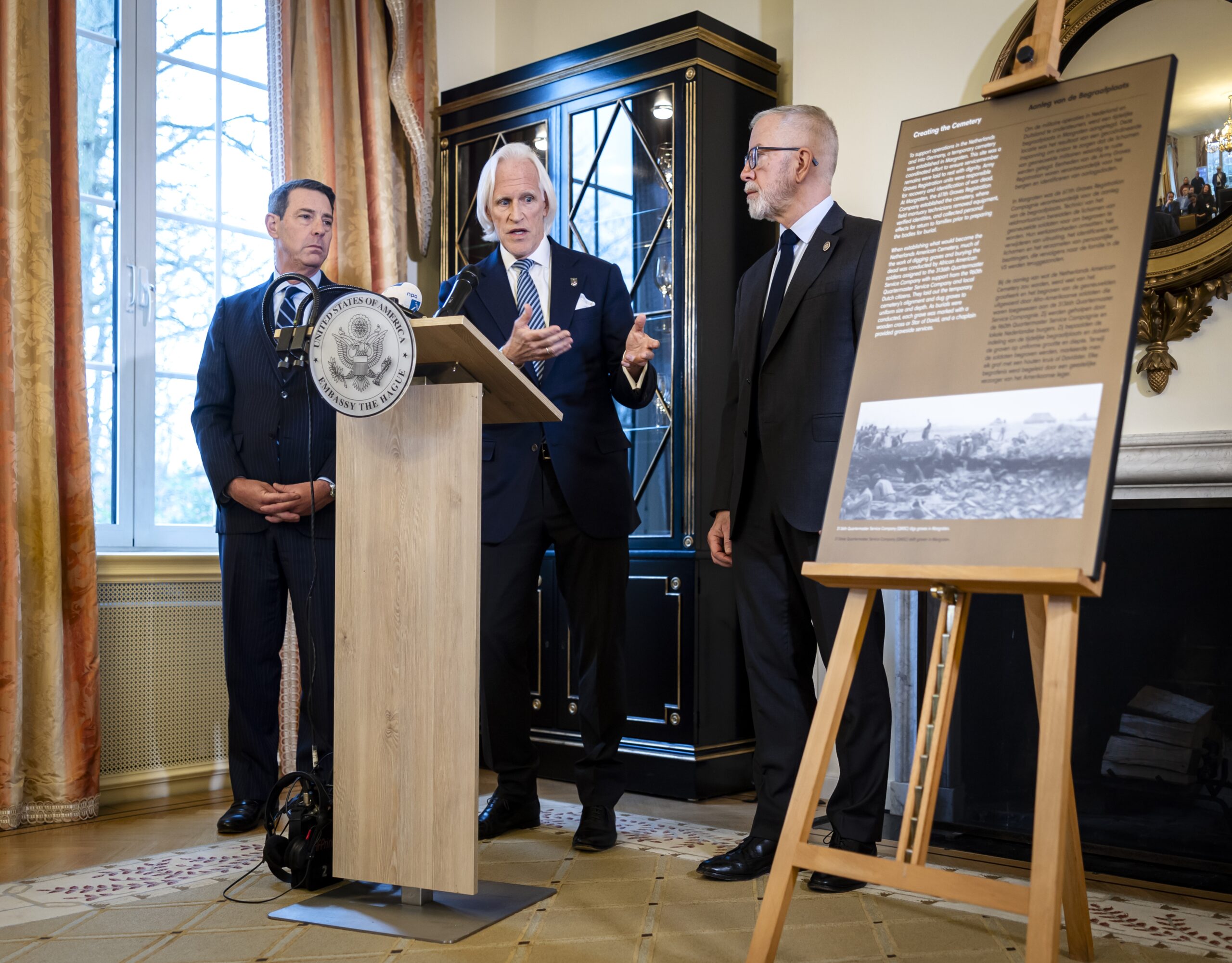
Ten new information panels have been unveiled for the American war cemetery in Margraten, including one focusing on the African-American soldiers who dug the original graves.
The other nine panels will be added to a rotating display featuring the stories of individual service members. They include two Black soldiers, one Native American and a woman who served as a nurse.
US ambassador Joe Popolo, who presented the panels at his official residence in The Hague on Monday, said the visitor centre displays were testament to the close relationship with the local population in Margraten who “have come forward and have taken over the maintenance of the graves.”
In November a row erupted over the removal of a previous panel describing how Black American soldiers faced discrimination in the segregated US army even as they fought to liberate Europe.
Relatives of soldiers buried at Margraten said the removal of the panels was “dishonouring” their memory and accused the Trump administration of trying to erase them from history.
Referring to the criticism, Popolo said: “It kind of hurt inside that the very, very important work that this cemetery has done has been misconstrued in some respects and frankly hijacked away from the purpose.”
“Whitewashed”
The new panel details the units that created the first, temporary cemetery at Margraten, including the 611th Graves Registration Company and two Quartermaster Service Company units – segregated units that dug the graves – but without quotes or testimony from the service members themselves, or any mention of segregation.
Kees Ribbens, senior researcher at the Netherlands Institute for War, Holocaust, and Genocide Studies (NIOD), called it “unsettling and disappointing”. He told ANP: “The text of the new panel makes no mention whatsoever of segregation in the US Army. In that sense the image has been sanitised or whitewashed.”
Stichting Black Liberators, a Dutch foundation that commemorates the Black American soldiers who served in the Netherlands, said the panel was “a step in the right direction” but it would continue to work to highlight “a painful aspect of history for both the veterans themselves and their relatives who should never be forgotten.”
A spokesman for the governor of Limburg, Emile Roemer, said it was “important and valuable to have Black Liberators forming a visible part of the presentation” and thanked the ambassador and AMBC for their efforts.
But he added that the new content “still does not fully do justice to the role and important of Black American service members, either in Margraten or Limburg. Their history is more than just their presence.”
Trump DEI order
The previous panel was removed in March shortly after US president Donald Trump issued an executive order, titled Restoring Truth and Sanity to American History, calling for public monuments to be purged of the “corrosive ideology” that presented American history as “inherently racist, sexist, oppressive, or otherwise irredeemably flawed”.
The mayor of Eijsden-Margraten, Alain Krijnen, wrote to the ABMC at the time asking for the story of the Black Liberators to be given “permanent attention in the visitor center”.
The panel was titled “Fighting on Two Fronts” and included a quote from staff sergeant Jefferson Wiggins, who was 19 at the time, describing how his comrades “cried when they were digging the graves … they were just completely traumatised.” It also described how segregation was abolished by President Truman after the war, in 1948.
The ABMC later said the panel would not be restored because it did not fit with its “commemorative mission”, despite calls from politicians in Limburg and relatives of fallen Black soldiers in the US to give ”permanent attention” to the story of the Black Liberators.
Omissions
At a press conference to unveil the new panel, the ABMC’s executive director, Thomas Spoehr, said the previous panel contained “omissions” that ”unintentionally excluded significant contributions to the temporary cemetery.”
Referring to the struggle against segregation, Spoehr said: “A visitor centre at the cemetery is not a general history museum. Our job in that visitor centre is to tell the stories of the soldiers and the sacrifices that they made.
“While racism and segregation is an important topic and one that needs to be talked about, it’s not part of the mission of the AMBC.”
Spoehr argued that the new panel was “more inclusive” because it referred to everyone involved in building the cemetery, including local Dutch citizens who helped out using tools from their farms.
“Partial fix”
Samuel de Korte, a Dutch writer specialising in Black American war history, described the new panel as a “partial fix” that failed to inform the public about the “core problem” of segregation and racism in the US Army.
”Black soldiers here fought a two‑front war: against Nazism and against Jim Crow,” he said. “As long as the story at Margraten omits that second front, the history remains incomplete and risks becoming a sanitized version that comforts us rather than tells the truth.”
As well as the gravediggers’ panel, nine panels have been added to the displays featuring the stories of individual service members, creating 24 in total that will be shown on rotation.
They include Private Richard Willoughby, from North Carolina, who was killed in action during the capture of the German town of Hann Münden, near Göttingen, on April 7, just before his 21st birthday.
Spoehr said Willoughby was one of more than 2,000 soldiers in segregated units who were drafted into the infantry during the campaign to liberate Europe in 1944.
New faces
Among the other new faces is Caswell Taylor, a private first class from Illinois, who was killed in a road collision a month before the liberation, while working on construction and water systems installations.
Private Jacob T. Herman Jr., native of the Ogala Sioux Tribe, was a 19-year-old paratrooper who died during Operation Market Garden, the failed attempt to liberate Arnhem in September 1944, while Christine A Gasvoda, one of four women buried at the cemetery, was a nurse who was killed in a plane crash during a resupply and evacuation mission.
Altogether 8,300 service members are buried at Margraten, including 172 Black Liberators, while another 1,700 names are inscribed on the Wall of the Missing. All of the graves are maintained by local Dutch citizens under an adoption scheme.
Last year the Monuments Men and Women Foundation launched its Forever Promise Project, which aims to connect the Dutch adopters with the families of the service members they commemorate. The programme includes a website with a searchable database of all those buried at Margraten.
Its chairman, author Robert M. Edsel, told the press conference that some 400 American families had been linked to Dutch grave adopters since the project was launched five months ago.
Thank you for donating to DutchNews.nl.
We could not provide the Dutch News service, and keep it free of charge, without the generous support of our readers. Your donations allow us to report on issues you tell us matter, and provide you with a summary of the most important Dutch news each day.
Make a donation