Descendants of Suriname’s enslaved people accept king’s apology
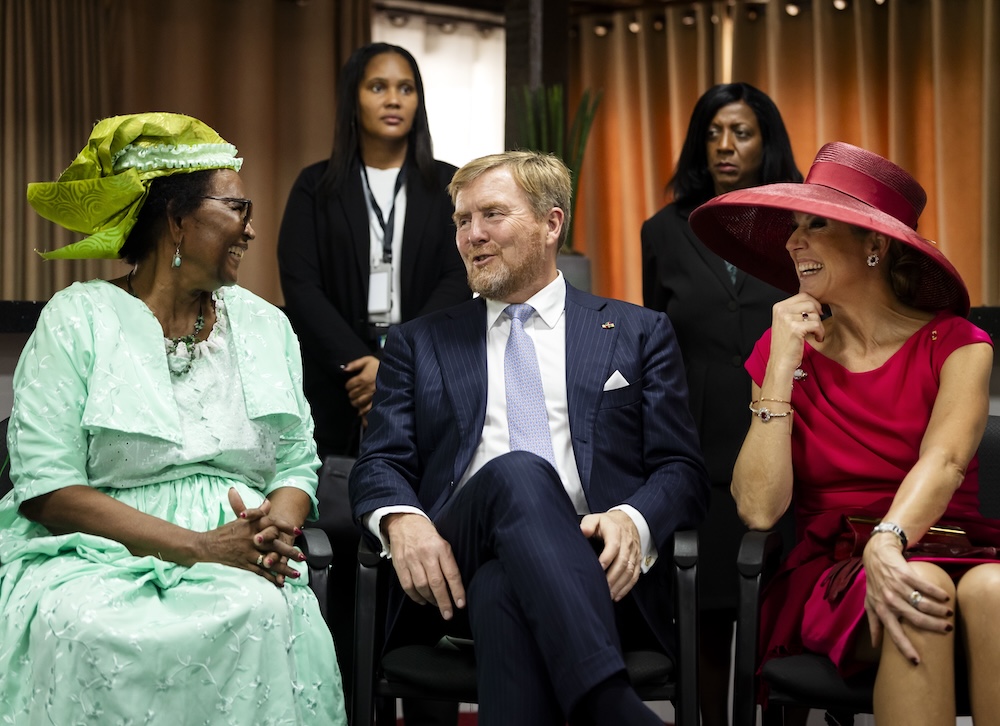
King Willem-Alexander and queen Máxima speak with the descendants of slaves. Photo: Remko de Waal ANP

Dutch king Willem-Alexander has formally apologised for the Netherlands’ role in slavery during the first state visit to the former colony of Suriname in 47 years.

The king met descendants of enslaved people and representatives of Indigenous communities behind closed doors on Monday, the first day of the royal visit.

The group had requested a conversation with the king following his apology during national commemorations marking the end of slavery on July 1, 2023. At that time, the king also asked for forgiveness and acknowledged that his ancestors had failed to act against the system of slavery.

Hesdy Ommen, chairman of the Federatie van Para Plantages, accepted the king’s apology on behalf of the group. “I accepted the apology and offered forgiveness on behalf of all the leaders,” he is reported as saying by news agency ANP. “From this point we must build on what comes next.”

After the meeting, Suriname’s president Jennifer Simons said the country now wants to start talks with the Netherlands about the recovery programme, for which €66 million was set aside in 2023.

Suriname, she said, should have a leading role in shaping and carrying out that programme. “The €66 million is not reparations according to the Surinamese government, and as far as I understand the Dutch government also sees it as a gesture,” she said.

The formal apology by the king in 2023 and prime minister in 2022 led to a string of measures and the establishment of a €200 million fund to raise “knowledge and awareness” and to combat racism.

The descendants of enslaved people can change their surnames free of charge. Tula, who led the slave population in Curaçao in an uprising against the Dutch colonial government in 1795, has been rehabilitated and Amsterdam is to host a museum dedicated to slavery.

Slavery was formally abolished in the former colonies of Suriname and the Dutch Antilles on July 1, 1863, ending a period of around 200 years.

However, enslaved people in Suriname were only fully freed in 1873, since the law stipulated a mandatory 10-year transition period. Suriname was declared independent on November 25, 1975.

Thank you for donating to DutchNews.nl.

We could not provide the Dutch News service, and keep it free of charge, without the generous support of our readers. Your donations allow us to report on issues you tell us matter, and provide you with a summary of the most important Dutch news each day.

Make a donation